Intuition is universal - access the site in your language
Pick your flag, refresh if needed.

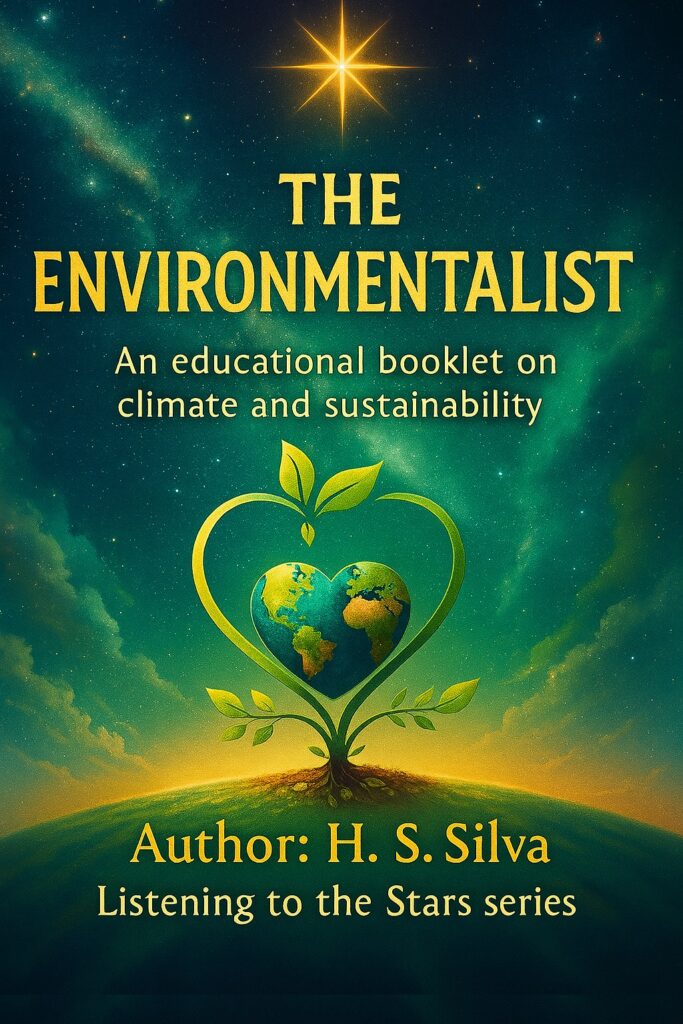
The Environmentalist

The Environmentalist is not just a reading experience — it’s a call to rethink our relationship with the planet.
Full book – in English,
now available here on the website.
Download the current version like on the website here

The Environmentalist is a compact and powerful booklet designed to raise awareness and inspire action. Through accessible language, hopeful prospects and engaging perspectives, it introduces readers to key environmental concepts such as Global Warming, the Greenhouse Effect, and the Ozone Layer. It explores urgent topics like Energy ProductionWater ScarcityDeforestation, and the Extinction of Species, while shedding light on the reality of Environmental Crimes.

This booklet also offers hope and direction: it presents Renewable Energy Sources, discusses Environmental Laws and Public Policies, and encourages Humanitarian Responsibility through practical, everyday Micro-actions

The Environmentalist is not just a reading experience — it’s a call to rethink our relationship with the planet.

Now available here on the site

The Environmentalist

‘Listening to the Stars’ Mini book Series

H. S. Silva

1st Digital Edition – 2025
ISBN – 978-65-01-79031-2

Listening to The Stars is a series of minibooks that invites readers to listen to what is not heard, and rediscover the wisdom woven into everyday life. Each volume is brief, poetic, and profound — a pause to breathe, reflect, and hear what lies beyond words.

Within this set of minibooks, “The Environmentalist” appears as the 16th volume, forming part of a collection of narratives that illuminate transformative encounters combining science, spirituality, nature, and humanity.

MINIBOOK ‘THE ENVIRONMENTALIST’
SERIES: “LISTENING TO THE STARS”
COPYRIGHT © H. S. SILVA 
Version – November 2025


I dedicate this book to environmentalists and to everyone who loves and cares for nature.

I think that ‘The Environmentalist’ is a statement of gratitude that was born and came to life with the perception of glimpses of life and the example of true guardians of nature, some known as Chico Mendes. Dorothy Stang and José Lutzenberger and other unknowns, but all so important!

Therefore, I dedicate this mini book to environmentalists and those who love nature and the environment! 

I believe that it is through love – sown in hearts – that the seeds of good and peace are sown on our planet.           

Believing in sustainability, environmental preservation and quality of life, respecting nature and ecosystems are legacies that environmentalists and those who love nature leave us.   

Let us make good use of them.

The Environmentalist is a compact and powerful booklet designed to raise awareness and inspire action. Through accessible language and engaging visuals, it introduces readers to key environmental concepts such as Global Warming, the Greenhouse Effect, and the Ozone Layer. It explores urgent topics like Energy ProductionWater ScarcityDeforestation, and the Extinction of Species, while shedding light on the reality of Environmental Crimes.

This booklet also offers hope and direction: it presents Renewable Energy Sources, discusses Environmental Laws and Public Policies, and encourages Humanitarian Responsibility through practical, everyday Micro-actionsThe Environmentalist is not just a reading experience — it’s a call to rethink our relationship with the planet.

Summary

DEDICATION

THANKS

ABOUT THE CENTRAL CHARACTER – FERHÉLIN

GUARDIANS OF THE EARTH

PREAMBLE

Ferhélin, the central character of the mini books was born in the interior of São Paulo, in the southeast region of Brazil. She has a degree in Physics and specializes in Quantum Mechanics.

Since graduating, a little more than six years before the publication of this book, she has worked as a teacher and researcher.

It is a young woman with brown eyes and hair that reaches her shoulders. At the time of the meetings narrated here, she was about to turn 30 years old.

Since she was a child, she learned at home the importance of seeking balance in life; and that the arts, sports and knowledge should always be present in their daily lives.

Thus, she naturally became an appreciator of music, works of art and literature; Still as a child, she learned to enjoy the pleasure of ‘sporting’ activities, having developed a special love for swimming and hiking, activities that, according to her statement, inspire her to reflect during her practices.

In terms of knowledge, she developed a love for learning, especially mathematics and physics, an area that she would dedicate himself to as a professional.

Spirituality, since she was a child, was part of her life with a practicing Christian mother and father. From an early age, she learned to respect and admire people who, regardless of the religious paths they declared, acted with a focus on the good; according to her testimony about the teaching she received from her parents, as a child.

It was after the publication of an article in an international scientific journal that she received an invitation to make a presentation on the subject at a congress in Canada, which she accepted and – from which, the meetings presented in the series ‘Listening to the Stars’ report Ferhélin’s experience on Canadian soil.

The story contained in this mini book of the series ‘Listening to the Stars’ is one of those selected by Ferhélin to be shared with readers.

The Environmentalist is an invitation to reconnect with the planet, to listen to the laws of nature, and to embrace a spirituality that honors life in all its forms.

Each reader is called to become a guardian of the Earth — a sower of hope, a cultivator of awareness, and a protector of what is most precious: life in its full diversity.

The topics explored in this minibook resemble the many facets of a diamond — each one reflecting a vital aspect of our relationship with nature. As we learn to respect and love the environment, these facets begin to shine, revealing the immeasurable worth of our planet.

Together, they form a single body: our living diamond — the beautiful planet Earth.

This minibook does not aim to exhaust the subjects it presents. Its purpose is to inspire: to spark reflection, awaken empathy, and encourage the conscious sharing of ideas that may blossom into transformative action.

As the author, I see myself as a researcher and curator of thoughts I believe to be urgent and meaningful. Within my reach, I’ve tried to feel what Earth’s true guardians feel — and to breathe life into this narrative with care, attentiveness, and affection.

THE ENVIRONMENTALIST

PART 1 – The Beginning

From the day she had returned to Banff, a cozy town located in the heart of the Canadian Rockies, Ferhélin had been eagerly awaiting the day when there would be a lecture on the environment and ecology – a topic that she greatly appreciated and would like to know more about. The title of the lecture was: ‘Environmentalism – perspectives for a better planet!’

When the day she had long awaited arrived, she went to the auditorium early enough to have a hot tea in the café that preceded the auditorium in tranquility, watching the arrival of the audience.

There, sensing the environment in which the lecture would take place, Ferhélin was surprised by the variety of age groups of the audience that arrived. From people with their white hair, to young people and even a group of girls and boys who appeared to be between ten and thirteen years old accompanied by two adults, a woman and a man, both in their 30s, probably a teacher and teacher of the children, she imagined.

Already in the auditorium, Ferhélin settled down and could observe that the lecture would have an audience of about three hundred people present. She could see that the group of children had sat in the first two rows, just in front of the stage. At the top of the stage there was a screen that projected images related to the environment.

Some time passed until the beginning of the event, when the presentation of the speaker of the evening was made: a Brazilian of Asian origin of light color and black hair that reached her shoulders, who appeared to be no more than thirty-five years old.

A summary of the speaker’s curriculum was made, with a brief history of her activities, which included studies in the area of environment and ecology, work with the United Nations Environment Program, participation in environmental congresses and assemblies and trips to several countries with experiences in different environmental realities on different continents.

Having the floor, she thanked the presenter of the event for the introduction and welcomed all those present and said that, during her speech, if there was any question, just raise your hand, that a microphone would reach the person, who could direct her question, her comment or even answer some of her questions addressed to the public.

Smiling, she said she would try to communicate with everyone present.

Looking at a couple with white hair, she said: ‘from the most ‘experienced’; looking at a group of teenagers, probably students from some school, she added ‘the youngest’, and even directed his gaze to the children in the first two rows, thanking everyone for their presence, but in particular she said that she was very happy for the presence of the numerous young people and children present. 

On the large screen in the background, the image of our beautiful planet appeared with the title of the lecture: ‘Environmentalism – perspectives for a better planet!’

Then, she invited all those present to observe the beautiful image of the Earth; saying that this was an iconic photograph of Earth taken by a space astronaut; Emphasizing that that image had become famous at the time it was taken. [1]

Soon she would enter the theme of the lecture:

– During our meeting, I will talk a little about some important concepts, about some topics that deserve attention and I will talk to you about the three ‘realities’ that appear in the image on the screen, okay?

On the screen in the background appeared three new images, one flanking the other. On the left, the image of a  large forest fire; in the central image, a group of scientists and young environmental apprentices appeared  in a natural setting with a stream, plants, vegetables and flowers; and in the third image, on the right, solar collectors and wind turbine units appeared  in the midst of the green of nature, with the blue sky above.

I would like to start by inviting all of you to do a little exercise in which we use our imagination – remembering to stay focused on the environment.

And she began to talk about the images that appeared in the background. There are three different perspectives. All three are real and exist at this very moment in which we are here. And they are related to each other, with one affecting the other.

Saying that she would like to talk a little about those three realities, she commented:

“I think that these three realities exist in relation to environmentalism on our planet and should be known, disseminated and taken into account by everyone.

Environmental crimes

The image on the left is a reality that we find on our planet, it is the sad realization of the devastation and damage caused by environmental crimes, with deforestation, fires and other sad realities, which I would like to make a brief approach with you.

This reality exists and should not and cannot be depreciated.

The idea here is to shed a little light on this obscure reality, which is that of environmental crimes. Who is interested in this reality? Why is it so obscure? Who wins with it? 

Scientific findings

As the central image, we see a group of scientists teaching young people about the environment. It portrays a different reality from what is often seen in the global landscape — a positive reality, one that inspires and brings hope.

This was a photo taken on one of my trips. It was in an environmental conservation unit located in a wonderful place in the Brazilian Midwest, in the Chapada dos Veadeiros National Park. In this image there is a meeting of environmental scientists with young people receiving environmental training.

In it, you see how the relationship with nature awakens enthusiasm, brings hope, and generates happiness.

After a brief pause – as if giving time to those present to assimilate their own feelings with the image, the Environmentalist continued her comment: – it is possible to see the joy on the faces of the photo, both of those who are teaching, and of the young people who are doing their experiments with plants or collecting water.

With this image, I would like to highlight the reality of the important work of environmental scientists and the scientific findings that, among their numerous attributions, point to the causes of serial catastrophic events and the intensification of the effect of the various climate crises that our planet has faced.

Good Perspectives

And, moving on to comment on the third image, with solar collectors and wind units, she said: – a third reality present on our planet, about which I would also like to talk to you in our meeting is that of the good perspectives that we have and that we can embrace and that, if applied as policies of governments of most countries,  would take our planet to a new level.

There are several possibilities to choose energy matrices that bring benefits to everyone on the planet and that encompass the various possibilities of cleaner and more sustainable energy models, such as wind energy and solar energy in the image. But in addition to these, there are other clean energy matrices.

Observing these three images that presented themselves one flanking the other, she continued:

– The question that arises is: what will prevail?

To which she, sketching a slight smile, said: “today, we are going to take a brief journey through various aspects that are related to the environment and we will go through these three realities that the images have shown us.

Ferhélin, who had sympathized with her from the beginning of her speech, from that very moment on, internally began to call her ‘The Environmentalist’.

THE BEGINNING OF THE LECTURE

Addressing everyone in the auditorium, she said: before we start our conversation, I will ask all adults and young people for a minute to exchange a few words with the children present here.

And looking at the children in the first two rows, she addressed them: 
– ‘imagine that some themes of what is going to be talked about today are like little seeds planted in the earth. Little seeds that you can water, take care of them and one day they can be born, blossom, grow, bloom and bear fruit.’ 

Some of the lines they will hear will be easier to understand, others may seem a little more complicated; Some I will try to explain today, but the doubts you take with you, remember to ask your teachers when you return to your schools. Remember to talk to each other, in your homes with your parents, and research what you hear here, okay?’

Some parts may like it more, others less, but remember: ‘they are like little seeds being planted’.

And, turning his attention to the general public, she said: initially, I would like to align some concepts with all of you.

At the outset, I would like to talk about global warming, the greenhouse effect and the ozone layer. These are three concepts that are much talked about when it comes to the environment. 

GLOBAL WARMING

Global warming deals with the abnormal increase in the average temperature on our planet. 

Since 1970, the average temperature on Earth has increased far beyond normal and this has consequences that affect the environment, human beings and everything that has life on our planet, so global warming is a serious problem.

It is a problem that  can still be solved, but for this there is a need to recognize the problem and want to solve it. This is the essential point to consider, wanting to solve the problem is fundamental. But the ‘want’ has to be translated into actions.

For the solution of any problem, it is necessary to understand it; identify the causes of the problem and, from there, work to eliminate its causes, or at least mitigate them.

Global warming is everyone’s problem; it’s a planetary problem. 

And we still have an impasse in this process. There are government leaders and officials who seem to turn a blind eye to the problem and continue to ignore it.

Thus, even with many warning of the danger of the situation, if the main countries do not engage in the search for solutions to global warming, the risk of worsening living conditions on the planet is great.

And, looking in the direction of the children, she said: “It is the role of each one of us to help, reminding government leaders and authorities that they are grandparents, parents, siblings, citizens and that environmental issues concern everyone, including them.

And, turning his gaze to the general public, she said: – ‘therefore, be aware of your ethical and moral responsibilities, above any other interests, and understand the urgency that is necessary in relation to the care of the environment of our planet. 

Somehow, as if the power of that speech had been transferred to each one of those present, everyone felt themselves bearers of the energy of that message, which should reach everyone, including government leaders and authorities.

THE GREENHOUSE EFFECT

Waves of harmony seemed to flow through the air of the auditorium. Seeming to be in tune with those waves, the Environmentalist continued:

– Another important concept that I would like to align with you is the greenhouse effect.

What is the Greenhouse Effect?

The greenhouse effect is a natural phenomenon, that is, it is part of nature and helps to maintain the temperature at levels suitable for life to exist on Earth.

The greenhouse effect consists of a layer of gases that surrounds the planet and works as a layer of protection for us, as if filtering the sun’s rays penetrate the planet at levels that allow us, animals, plants, forests, fish, birds and everything that has life to stay alive.

And, continuing her explanation, she posed the question: – ‘ If this is so, then why do you relate the greenhouse effect to something negative?’

To which she herself replied: – ‘because gases are being thrown into the atmosphere at levels far above acceptable!


And why do these gases cause damage?

Let’s think together: the normal thing is that the Earth is not too cold or too hot, to the point that we cannot live on the planet; Not in one extreme of freezing, nor in another extreme of overheating, correct?

The problem that is being found by scientists is that these gases that are being ‘thrown’ in excess into the atmosphere that surrounds the Earth absorb part of the infrared radiation[2] reflected by the Earth’s surface. 

Normally, there is a range – with a minimum limit and with a maximum temperature limit, within which we can live.

The worrying thing is that environmental scientists have found that an increase in temperature is occurring far beyond normal levels on our planet.

And, in the context of rising temperatures, the question arises:

What is the relationship between global warming and the greenhouse effect?

With the emission of gases happening in excess, the radiation that should be directed into space is ‘trapped’ in the atmosphere and causes an increase in the warming of the Earth’s surface.

In the study of the increase in temperature on our planet, the indications are that the pollution caused by gases intensifies the Greenhouse Effect.

In other words, global warming is a climatological event that occurs with the increase in the Earth’s average temperatures, both on the continents and in the oceans. 

And the fact is that the phenomenon of disordered global warming is the result of the intensification of the greenhouse effect.

Then, addressing the audience present, she asked: if someone asks you ‘why is the temperature rising beyond normal levels?’ What will be your answer?

To which, soon, a young woman who identified herself as a student in the last year of the school said:

“The temperature is rising beyond normal levels due to pollution caused by gases that produce the ‘Greenhouse Effect’. Correct?”

To which the Environmentalist remarked: ‘correct!’ To then present a new question to the audience: do you know what the main greenhouse gases are?

The main Greenhouse Gases (GHG)

One person answered ‘carbon dioxide’, another said ‘methane’.

To which the Environmentalist agreed, saying:

The major causes of the Greenhouse Effect are carbon dioxide (CO2), methane (CH4), nitrous oxide (N2O), ozone (O3) and fluoride gases such as chlorofluorocarbons (CFCs), sulfur hexafluoride (SF6), hydrofluorocarbons (HFCs) and perfluorocarbons (PFCs). [3]

GHG 1 – Carbon Dioxide (CO2)

 Carbon dioxide (CO2) is the most abundant gas in the atmosphere, reaching 55% of the world’s greenhouse gas emissions. This gas is generated by fossil fuels, such as coal and oil.

GHG 2- Methane Gas – CH4

Another gas that contributes greatly to the increase in the Earth’s temperature is methane gas.

This is a gas with power twenty-one times greater than carbon dioxide.

About 60% of methane emissions come from human actions, such as livestock, landfills and dumps.

According to the International Energy Agency, agricultural activity, which includes animal husbandry, makes up the largest human source of methane emissions on the planet, and in the livestock sector, cattle are undoubtedly the largest emitter. The rest of its production takes place through ruminant animals (burping) and natural sources, such as volcanic eruptions.

On a daily basis, methane is generated when mineral fuels (mainly oil)  are extracted;production of fossil fuels (gas and coal) and burning of fossil fuels (vehicles).

The interesting thing is that it can also be used as biogas for energy generation. In other words, there is the harmful side, but if there is good management of its use, this gas could contribute to the positive side.

An interesting article that I suggest reading is the one from the BBC, which has the title ‘The surprising sources of greenhouse gases.[4]

In this article, written by a team of BBC journalists, they made an observation that I think is pertinent to reproduce for you here: it is that ‘methane has spent a long time in the shadow of CO2. But its impact on global temperatures is very large. Therefore, it is vital to start getting to know him better.’ 

By the way, here is the suggestion for those who appreciate good reading, to visit the ‘BBC Innovation‘  website[5]. There are always good topics being presented there.

GHG 3 – Nitrous Oxide – N2O

Another gas that contributes greatly to the increase in the Earth’s temperature is nitrous oxide, also known as nitrogen oxide (N2O).

Nitrous oxide is a GHG three hundred times more potent than CO2.

Agricultural practices are the main sources of nitrous oxide from human action. Examples of these activities are soil cultivation, use of nitrogen fertilizers, and waste treatment. The power of nitrous oxide to increase temperatures is two hundred and ninety-eight times greater than that of carbon dioxide.

Interestingly, nitrous oxide is also an analgesic/inhalational anesthetic used in a mixture with oxygen (O2) in concentrations that usually vary between 40 and 70% and has been used for more than 160 years for the induction and maintenance of anesthesia in patients during surgery. 

It is also known as the “laughing gas”. It is a non-flammable and colorless gas, with a slight odor and a sweet, pleasant taste. The low cost and toxicity make nitrous oxide commonly used during general anesthesia.

GHG 4 – Fluoride Gases

 Fluoridated gases also contribute greatly to the increase in the Earth’s temperature.

As an example of these gases, produced in order to meet industrial needs, we can mention hydrofluorocarbons, used in cooling and refrigeration systems; sulfur hexafluoride, used in the electronics industry; perfluorocarbon, emitted in the production of aluminum; and chlorofluorocarbon (CFC), responsible for the destruction of the ozone layer. 

For example, the global warming potential of perfluorocarbons (PFCs), used as gases in refrigerants, solvents, propellants, foams and aerosols, is 6,500 (six thousand five hundred) times to 9,200 (nine thousand two hundred) times stronger than that of CO2.

Summary: The problem is not the greenhouse effect, but its distortion, caused by the gases known as GHG – Greenhouse Gases.

Remembering that the greenhouse effect is originally a natural mechanism that exists in order to promote climate balance on our planet, it is worth remembering that, in addition to these gases, there is water vapor, which is very present in the atmosphere.

Water vapor captures the heat radiated by the earth’s surface, distributing it and heating the surface.

Thus, the problem is not the greenhouse effect, but its distortion, which occurs due to uncontrolled activities that are responsible for the excess emission of greenhouse gases, which are: rampant deforestation; criminal fires; excessive burning of fossil fuels and industrial activities that prioritize profits and productivity, ignoring the effects of their actions.

OZONE LAYER

Another concept that is often mentioned when it comes to climate crises, which I would like to talk to you about, is that of the ozone layer.

Asking next: do you know what ozone is?

Soon, a young black man who appeared to be in his early twenties replied: ozone is a gas!

To which she added: ozone (O3) is a gas that exists in the atmosphere. 

This gas forms a protective layer – called the ozone layer.

And what is this ozone layer?

A question that she herself answered: it is a layer of gas that forms in the atmosphere between 20 km and 35 km in altitude with the aim of absorbing solar radiation, blocking the entry of a large part of ultraviolet (UV) rays.

Everyone here has used sunscreen, okay? The kind we sell in pharmacies and supermarkets and use when we go to the pool, the beach or when we are going to be more exposed to the sun. Do you remember them? It has factors 30, 50, etc. It protects our skin from excess UV rays, so that there are no burns, skin cancer, etc.

The ozone that exists there in the atmosphere and forms this layer of ozone gas is produced naturally.

We all know how important the sun is in our lives. Without the sun there would be no life on the planet. We can understand the ozone layer as being the planet’s sunscreen. It has the important role of protecting the planet and all of us, preventing extreme heat.

Hole in the ozone layer

The problem happens when areas of the atmosphere emerge that run out of enough gas to keep the ozone layer active. This is when the so-called hole in the ozone layer appears.

And why do holes appear in the ozone layer?

Holes in the ozone layer occur as a result of polluting gases emitted by human activities that react with ozone and turn it into oxygen and destroy parts of the ozone gas layer that protects the planet.


[1] [Note 1] – Image that became known as Blue Marble. One of the most iconic photographs on Earth, taken by a space astronaut. Photo taken in December 1972, during NASA’s last manned mission to the Moon. NASA credits the photograph, taken at a distance of approximately 45,000 km from Earth on its way to the Moon, to the entire Apollo 17 crew. 
To see the image in its original size visit the website: https://go.nasa.gov/3VDWmg1

[2] [Note 2] Infrared radiation: radiation related to heat. Infrared radiation can be emitted by any hot object and by the Sun by emitting waves with a frequency below the frequency of red light. Hence the name: infrared.

[3] Hydrofluorocarbons (HFCs) These are chemical compounds consisting of hydrogen, fluorine and hydrocarbons. Refrigerant gases  used in air conditioners, fire extinguishers and as solvents. Perfluorocarbons (PFCs) are organic compounds made up of only carbon and fluorine atoms, with chains of up to six carbon atoms. They are known as Greenhouse Gases (GHG) because they interact with solar radiation and contribute to the intensification of the greenhouse effect.

[4] [Note 4] BBC article – ‘The surprising sources of greenhouse gases‘ Link: https://www.bbc.com/future/article/20240402-the-surprising-sources-of-methane.

[5] BBC Innovation – https://www.bbc.com/innovation


PART 2 – Our Self-Portrait as a Society

Following the topics I planned to present to you, I would like to talk a little about the Energy Matrix.

What is the energy matrix?

The energy matrix is the grouping of energy sources that are used for energy generation.

Each country has its energy matrix, making use of the resources it has at its disposal, in order to meet its energy demands.

Therefore, the energy matrix of each country shows us what resources are used to produce the energy consumed in that country.

I think that the energy matrix, in some way, presents our self-portrait – as humanity and society. It is a statement that expresses how we relate to the resources we have at our disposal.

I will talk a little about the current energy sources that are most used on our planet; about emerging energy sources and about possible sources that, perhaps, can make up the energy matrix in the future.

From Non-Renewable Resources

In terms of the energy sources that we use the most today, I would like to start by reminding you that most of the current energy sources on our planet come from non-renewable resources, with more than 80%, which is a very high percentage and involves oil and derivatives, coal and natural gas. 

Among the various uses of energy sources, I would like to remember one of the most impactful applications – which is fuel.

Therefore, I would like to talk a little about new fuels. And why talk about new fuels?

Because the predominant energy matrix in most countries is composed of non-renewable energy sources and the objective is to reduce the amount of gases that current fuels cause in the greenhouse effect in the atmosphere. They cause great damage to the atmosphere and are responsible for the well-known ‘holes’ in the ozone layer.

Most non-renewable fuels come from oil and its derivatives.

At this point, a little girl in the front row of the auditorium asked: ‘If oil is the cause of so many problems, then why does it continue to be used?’

The Environmentalist looked fondly at the little girl and, taking a deep breath, paused, as if reflecting on the question, before answering it. You know, this question of yours is very good. So good that it should be answered by the leaders of the countries, by the presidents, by the congressmen and, especially, by the heads of the oil companies.

Looking at the girl, she asked her how old she was; To which the little girl replied: 11 years.


The Environmentalist then continued: I think that if they hear the question coming from you and see the sparkle in your eyes, as I can see from here, each one of them would give an answer that might surprise themselves.

But I will try to give you an answer.

Oil and its derivatives dominate the economic market. In simple words, ‘worth a lot of money’. 

So those who dominate oil, whether countries, investor groups or oil company owners, don’t want to stop earning from what generates gains for them. That is one aspect.

But there are other particularities; Among them, that everything today, in some way, has some level of dependence on petroleum products. And when there is dependence, it is as if there were an addiction. And it’s never easy to quit an addiction.

But, you know what, I believe it’s not that difficult to end an addiction. I firmly believe that a good method for letting go of something, or an unwholesome habit behind; It is creating a new, better, healthier habit that brings even more benefits than the person could imagine.

An example: imagine that a person wants to stop eating meat.

It is not enough for her to simply want to stop eating meat. By doing so, she will soon feel that ‘something’ is missing.

But if, when she proposes to stop eating meat, she researches other foods that she was not used to consuming, and discovers that those foods, well seasoned, well-made and combined with others are very tasty, and still have good food nutrients, she can say: – you know what, I’ll try it!

And when you start experimenting – with a new focus, that of creating new eating habits for yourself, you may find that you enjoy foods such as legumes, grains, seeds, fruits, beans, lentils, chickpeas and oilseeds, such as chestnuts, almonds, peanuts, walnuts, sesame and sunflower.

And if, in addition to the new combination of well-seasoned foods, she discovers that many of them are excellent sources of protein and provide several other benefits that she had not even thought of, over time, she will not even remember what she stopped eating. And a new habit begins to prevail. 

Pausing in the flow of the narration, as if giving everyone present a break, so that they could perceive the analogy she made, she continued:

– The predominance of fossil fuels in transport is a finding. The use of diesel and gasoline is great. 

Both gasoline and diesel are fossil fuels extracted from oil, but the situation gets even more serious; The gases resulting from the combustion of diesel are four times more polluting than gasoline.

Returning to the analogy she had made, she continued:

“I believe that when a change in ‘habits’ occurs in relation to fuels and energy sources, there will be gains for everyone – including economic ones.

Every new technology, over time, has more efficient production and logistics processes and starts to cost less and become easier to use.

In environmental terms, studies show that the replacement of non-renewable fuels with renewable and sustainable energy sources is essential for saving the environment.

Environmental and Economic Changes

When entrepreneurs and people in general realize that new, more sustainable models are good for them, and that they will generate even more profits – with less costs, less waste, more energy efficiency, less dependency, less negative impacts on health, as well as creating more accessibility and advantages for all, including the most deprived and isolated populations; then ‘new habits’ will naturally replace ‘current habits”. 

In other words, ‘new fuels’ will replace ‘current fuels’.

Examples of Less Polluting Alternatives Already in Use Around the World

In recent years, we’ve witnessed a true revolution in how we produce and consume energy. The search for cleaner and more sustainable sources has inspired creative and effective solutions across many countries.

Today, I’d like to share with you some examples of alternative, less polluting fuels that are already being used around the world — and that represent real pathways toward more conscious mobility and a healthier planet.

Let’s take a look:

  • Ethanol, produced from sugarcane, corn, or beetroot. In Brazil, ethanol is widely used as a vehicle fuel, either blended with gasoline or used pure in flex-fuel engines.
  • Second-generation ethanol, made from agricultural residues such as straw and bagasse, increasing efficiency without competing with food production. Brazil is making solid progress in this technology and may offer promising solutions.
  • Bioethanol, a variant obtained through biomass fermentation, already present in some European countries.
  • Biodiesel, derived from vegetable oils or animal fats, used in public fleets and trucks.
  • Electricity, powering electric vehicles — like those in cities such as Oslo, where over 80% of new cars are electric.
  • Biogas, generated from the decomposition of organic waste, used in urban buses and even transport trucks.
  • Kinetic energy, harnessed through regenerative braking systems found in hybrid vehicles.
  • Nitrogen, still in experimental stages, but with potential for use in refrigerated transport.
  • Solar energy, used in solar vehicle projects and for battery recharging.
  • And of course, hydrogen, which we’ll explore further ahead, given its enormous potential as a clean and efficient fuel.

Each of these alternatives represents not only a technological innovation but also an ethical and ecological choice. They are seeds of transformation already sprouting in different parts of the world — and they can flourish even more with our collective engagement.

“And it doesn’t stop there, folks. Energy innovation is constantly evolving, and new alternatives are emerging with great potential. Take a look at a few more examples that deserve our attention:”

Synthetic Gasoline (e-Fuel)

  • Artificially produced through chemical reactions between hydrogen and carbon dioxide.
  • Example: Porsche has already begun production in Chile, promising up to a 90% reduction in carbon emissions.
  • Can be used in conventional engines without the need for adaptation.

Green Diesel (Renewable Diesel)

  • Unlike biodiesel, it is chemically identical to fossil diesel but made from renewable raw materials such as vegetable oils.
  • Example: Already used in urban fleets and approved for blending in any proportion.

Biomethane

  • A purified version of biogas with high calorific value.
  • Example: In Brazil, the cosmetics company Natura uses biomethane in its transport fleet, reducing emissions by up to 85%.

Lactose-Based Fuel

  • Yes, even milk can become energy! Experimental research has already transformed lactose into liquid fuel.
  • Still in testing phases, but it shows how creativity can lead to surprising solutions.

These alternatives show that the energy transition doesn’t rely on a single solution, but rather on a set of technologies that can be adapted to local realities. The key is to stay focused on reducing environmental impacts and promoting a circular and regenerative economy.

After sharing those insights with contagious enthusiasm, the Environmentalist took a deep breath, looked out at the audience, and said:

— As someone deeply committed to environmentalism, I believe that every technological advancement is an opportunity to reconnect with the planet. And that knowledge, when generously shared, becomes the light that guides us on this collective journey.

She paused briefly, then continued:

— In light of what we’re witnessing, I truly believe it’s possible to accelerate the diversification of our energy matrix by expanding the use of more sustainable energy sources and fuels across the globe.

— And when this shift becomes predominant — generating new economic opportunities, dignified jobs, and outcomes far beyond what we currently imagine — humanity will have reached a new threshold. A time of greater awareness, deeper fulfillment, and renewed harmony between people and the environment.


Energy Production 
– Beyond Conventional Fuels

The Environmentalist stepped forward, her gaze steady, her voice calm: “Let us continue our journey of reflection. Now, I’d like to talk about energy production — going beyond conventional fuels.”

In practice, what we observe today is that energy generation remains largely tied to fossil fuels. Among them, coal ranks highest when it comes to greenhouse gas emissions.

Despite mounting international pressure, new coal plant projects are still underway — especially in developing countries like China and India, but also in developed nations across Europe and the United States.

The Environmentalist paused briefly, inviting contemplation, then continued: “Isn’t it astonishing? In the 21st century, with so many scientific warnings and clear evidence of climate impacts, we still choose paths that distance us from planetary regeneration.”

She gestured toward a projected chart behind her, citing a reliable source: A suggestion for those who wish to track this data closely: the nonprofit organization Global Energy Monitor monitors energy projects around the world.

But coal is not the only villain. There’s an even more alarming practice: fracking — a technique used to extract natural gas from underground. This process involves triggering underground explosions to fracture rock formations, allowing gas to escape. To do so, chemical solvents, water, and sand are injected at extremely high pressure.

Studies show that fracking can release methane at levels up to 25 times more harmful than carbon dioxide (CO₂), further intensifying the greenhouse effect.

The Environmentalist turned to the audience with a look of sorrow: “Those responsible for these decisions — whether government leaders or supporters of such practices — seem unaware of the harm they’re causing to the planet and to humanity itself, of which they are a part. They forget that the damage isn’t distant: it may affect them directly, or their descendants. And by that, we mean all of humankind.”

Side Effects

Fossil fuels are major emitters of atmospheric pollutants, directly linked to the greenhouse effect and global warming.

These and other environmental issues stem from political choices and energy models that ignore the devastating impacts underground — affecting even aquifers and natural water sources, true treasures of the planet.

Not to mention the pollution of rivers, lakes, oceans, cities, and the atmosphere itself.

There are habits we’ve developed and normalized, but in truth, they are traps we’ve set — and they take time to be recognized as causes of irreversible damage to the planet.

The Stage of Decisions — or the Stage of Omission?

This is a long-term problem. But what we call “long-term” may knock on our door sooner than expected.

For decades, warnings were issued about the risk of rising global temperatures, predicting that such changes would occur in a distant future.

Thus came the climate agreements, with goals and commitments signed by various nations.

But what happened?

Few countries met their targets. In reality, we see a planet in agony, overwhelmed by climate disasters: forests and thousands of species wiped out; populations affected by heatwaves and cold spells, droughts, wildfires, torrential rains, floods, landslides, windstorms, cyclones, tornadoes, and hurricanes.

All of this could have been prevented — or at least mitigated — if the signatory countries had honored their commitments. The temperature rise, once forecasted for the “long-term,” arrived early and is now part of our planetary reality.

What’s worse is that some of the world’s leading nations — those who claim to lead — have consciously and deliberately opposed the adoption of many proposed measures. By doing so, they not only worsen current problems but also destroy any chance of success for future generations.

In practice, the omission of leaders and the lack of investment in environmental care and oversight — including the training and recognition of professionals in the field — have created a vast gap between unfulfilled promises and the reality we now face.

Therefore, the cause of climate crises is not natural. Many of those most responsible for the series of catastrophic events the planet is enduring remain on the stage of decisions — or perhaps, more accurately, on the stage of omissions.

PART 3 – The First Reality

Having given a brush stroke on Solar Warming, the Greenhouse Effect, the Ozone Layer and our Energy Matrix,  I would now like to enter into one of the three realities I spoke of at the beginning – these are the findings that the sciences have shown us. I will talk about some topics that have been followed by scientists and that have to do with the environment.

SCIENTIFIC FINDINGS 
– first reality –

The sciences provide us with the most varied scientific information and many of them indicate the risk of species extinction, increasing soil degradation, worsening levels of air pollution, increased deforestation rates, decrease in water resources and a number of other findings that should receive the attention of all those who aim to preserve our planet.

There are countless environmental impacts that have been observed since decades ago and have been intensifying day after day.

On the large screen at the back of the stage, in sequence, four images emerged: first, the image of a scientist collecting turbid water from a river; then, the image of an open-air dump; then the image of a mega traffic jam at the beginning of the night with thousands of cars in a large city and then the image of several skeletal children on the dirt floor, surrounded by a missionary with a skinny child on her lap.

The Environmentalist looked at the images. And, as if inviting everyone to, more than observe the images, to feel them, she commented:

– The first image shows us a person collecting water in a river; Like that person, in several other areas, there are many missionaries of science and technology, who are incognito working for the improvement of our planet;

– The second image shows us a common scene in many cities, with thousands of cars – in a traffic jam – most of the cars with a single person inside. They are good people, who would probably like to be in their homes already, perhaps with their children, wives, husbands; maybe? But they are there in the middle of that tangle of cars and are still polluting the cities in which they live. 

Certainly, they would prefer not to be there, contributing to pollute their cities.

– And this last image reminds us that our dear planet and all who inhabit it need human love and respect, so that the present and the future do not appear too cruel to its inhabitants, especially the most needy, who are the first to suffer the effects of any and all crises,  including the climate crisis.

Then, she was silent, for a moment, as if giving us the chance to absorb the feelings that those images aroused, and then to ask the question:


Our lifestyle has affected the health of our planet. The problem that arises is: we are polluting our planet and causing problems for it to function normally.

Everything we do involves the use of natural resources, the issues to consider are:

Are we making good use of the natural resources we have at our disposal?

Are we using natural resources in a conscious and minimally intelligent way?

The answers to these questions are: no!

And why not?

Because what we are doing is preventing the natural systems of the planet from protecting us and providing us with living conditions on it.

A simple example is the observation of the increase in temperatures, which cause imbalances in nature that result in changes in the behavior of the atmosphere, with intense heat waves, excessive cold, enormous droughts, voluminous rains, floods and landslides. That’s only part of the problem.

Now, on the screen in the background, images of floods and landslides appeared

These images only illustrate the question: what is happening in the world today? Now, I ask the following question:

To answer this question, I will invite you to watch an excerpt of one minute or less from a film. On the screen appeared an excerpt from a cartoon based on the book ‘Alice in Wonderland’ [Note[1]].

In that part of the drawing, Alice asks the Cat: “Can you tell me, please, which way I should go to get out of here?” 

The Cat says to Alice, “That depends a lot on where you want to go.”

Alice’s response: “I don’t know where I want to go.”

Cat’s response: “So any path will do.”

The drawing stopped being shown and with this last sentence on the screen, the Environmentalist continued by saying:

– That’s what I’m talking about today. If we don’t know where we want to go, what awaits us?

After another brief pause, she continued:

When we think of conscious leaders, who believe in a better world, I think they ponder the paths to which their choices lead, right?

So, we can say that they would opt for energy solutions that contribute to a more sustainable planet. And not options that harm the planet and cause problems for everyone who lives on it. Agree?

And, looking in the direction of the children in the first two rows of the auditorium, she concluded:

This is what everyone expects from conscious leaders! 
And you are the leaders of tomorrow!


[1] [Note 7] Work: Alice in Wonderland by Lewis Carrol 

RELEVANT TOPICS (1)


A few moments passed.

On the large screen at the back of the stage appeared the image of a beautiful park on a sunny day, with groups of people with children playing, young people and adults having fun, some reading, others playing music outdoors and others just sitting or lying in the middle of the lawns, gardens and trees

The image inspired a sense of harmony.

The Environmentalist – with her back to the audience and looking at the screen, as if feeling part of that image, commented: ‘us and nature, what a beautiful combination when there is harmony!’

Soon after those words, while the image in the background was replaced by another one – of the beautiful Lake Louise, which had so enchanted Ferhélin, the Environmentalist, turning to the audience, said:

Now, I would like to talk a little about the work developed by researchers and scientists who have dedicated their lives to research and studies on ecosystems, climate change, extreme weather events, rising global temperatures, degradation of natural habitats and several other aspects that impact the environmental balance on Earth.


Within the scope of scientific findings, I will start with the topic that touches my heart the most: water!

We know that approximately 70% of the Earth’s crust of our planet is covered with water, and of this total, about 97% are saltwater from the oceans and seas and only 3% are freshwater, and within this small percentage, there are glaciers that add up to 2%, that is, there is only 1% of all the water on the planet available for human consumption.

Rivers, lakes and underground aquifers are the recipients of this wonder that is the drinking water that supplies us and feeds us all – humans, birds, animals, fruits, vegetables, flowers, plants, forests and everything that lives on the surface of our planet.

But what’s going on?

We are polluting the surface waters of our planet. In other words, we are throwing garbage, sewage and dirt into our rivers and lakes.

Now, on the screen appeared the sad image of a river with water polluted by the sewage that reached the riverbed, which was full of foam and plastic bottles.

We know that the demand for water is growing around the world and we also know that in several regions of our planet there is a shortage of drinking water. This is a finding, which points out that drinking water levels in several regions are approaching critical levels and that the levels of what is considered safe have already been exceeded. 

It sounds insane, but this is what is happening: we are making the drinking water we have at our disposal unhealthy – the water that feeds, that heals and that is sacred to the original peoples of the forests, but which seems to be the enemy of societies that consider themselves ‘cultured’ and ‘developed’ or in ‘development’.

And with this reality, a trap arises that goes unnoticed by many. It is related to our relationship with water on our planet.

By making fountains, rivers and lakes unhealthy, what have our societies, which consider themselves intelligent, begun to do?

They began to make use of water from aquifers. As she said this, she paused briefly to drink a glass of water, giving the impression that she was savoring that water while drinking it.

That’s when a little girl, who was sitting in the front row, raised her hand and asked:

The Environmentalist seemed happy with the question and, looking at the little girl, then answered: imagine immense natural ‘water tanks’ that exist in the subsoil of our planet.

They exist and are between 50 and 1800 m deep. Imagine also that, in addition to these water tanks, there are large ‘natural sponges’ that absorb water. These ‘sponges’ are porous, permeable sediments that absorb water inside the earth.

These waters – which are in the ‘immense underground water tanks’ and the waters that are in the ‘large natural sponges’ of the subsoil are the waters that form the aquifers.

And what are these waters? It is part of the water called groundwater.

These ‘immense water tanks’ are distributed in underground geological formations and receive water that has infiltrated since more than 100 thousand years ago. They are ‘geological natural containers’ that store and transport water and that form what we call aquifers. 

Aquifers are extraordinary natural resources of incalculable value.

And, looking at the little girl who had asked the question, the Environmentalist asked: did I manage to be clear? Did you get an idea of what aquifers are?

The girl smiled saying that yes, she had understood.

To which the Environmentalist, turning her gaze to the audience present, continued:

– With surface water reaching a critical level, due to surface water pollution, what was the solution of people who consider themselves developed?

They began to make use of groundwater.

At first, one may think: but what is the problem with this? 

In normal times, the natural cycle caused rainwater to deepen and reach these natural reservoirs, which are aquifers.

But with the increase in the planet’s temperature happening above the worst expectations, there is less rainfall and; another serious occurrence, the water from the little rains and the weak rains evaporates more quickly, before going deeper into the ground and ending up not reaching the aquifers.

Looking especially at the children in the front row, she asked? Do you realize what is happening?

Some of the children responded by moving their heads in agreement and others said ‘yes’ and a young boy added: “the ‘water tanks’ are starting to empty”!

To which the Environmentalist, looking again at the little boy who had spoken, smiled in agreement, saying: yes, the volumes of nature’s water tanks are decreasing.

Turning his gaze to the audience, she added: “This occurrence is being verified by experts and the volumes of the aquifers are decreasing.

But, in addition to emptying, there is the concern that, if the exploration of aquifers is not done correctly, there may be contamination of those waters. In other words, we would be polluting those waters too.

For some, emptying aquifers does not seem like a problem, as they think it would take too long to dry up the aquifers. But environmental scientists find that, with the increase in the planet’s temperature, and with less rain than expected, the water from the few rains evaporates faster, well before it reaches the ground. And what ends up happening is that there is more water leaving than entering various aquifers. [[2]]

Ending her speech about water, the Environmentalist concluded: – The fact is that we should take better care of the surface waters, depolluting where the water is polluted, taking care of, cleaning and beautifying the rivers and lakes we have.

And we should make use of water from aquifers only in places where there is no better option. So, the idea is simple: let’s leave our aquifers alone, accumulating their waters.  


[1] – Themes inspired by studies conducted by researchers  at the Potsdam Institute for Climate Impact Research (PIK) – PIK is an Institute dedicated to scientific issues in the areas of global change, climate impacts and sustainable development. Ranked worldwide as one of the leading research institutions and part of a global network of scientific and academic institutions working on environmental issues.

[2] Suggested BBC article for reading – https://www.bbc.com/portuguese/brasil-60962619 and also reading a G1 article  https://g1.globo.com/jornal-nacional/noticia/2024/10/11/chuvas-nao-estao-sendo-suficientes-para-repor-volume-de-agua-do-aquifero-guarani-diz-estudo.ghtml#

On the screen, a new image appeared, this time of a clearing seen from above in the middle of the forest. Around the clearing, trees, but in the middle of the clearing, the dirt floor with tree trunks already on the ground being pushed by huge tractors.

Observing that image, the Environmentalist commented:

“Deforestation is one of the most relevant environmental problems in our history.

Devastating forests and depleting natural resources are not at all compatible with intelligent attitudes. Even so, human beings consider themselves intelligent. Is it really?

Would an intelligent society ignore the abusive exploitation of the resources that nature provides, compromising the balance of the planet and annihilating the ecosystems that sustain life on the planet on which they live?

Pausing as she scanned with her gaze, which seemed to run across the auditorium, she said:

– Poor land use starts with small choices that may seem harmless.

You can start with the choice of ‘cementing’ a yard or cutting down a tree.

When people opt for actions like this, they don’t remember the birds that could frequent that environment or even that they could raise other animals there.

People even forget the fact that their children could walk barefoot or play in the ‘dirt’ or on the lawns of those backyards.So, the simple acts of cementing a yard or cutting down a tree, in many cases, constitute an example of poor land use.

Another example of how to misuse the land is the channeling of rivers and streams. These choices have negative impacts on the environment.

It seems that it is not a big deal to channel a river, but when it does, the speed of the water increases, and intensifies its destructive power. And when torrential rains occur, what happens to the water that spread in the escape areas that ceased to exist and started to be occupied by houses or buildings?

Not to mention that, in many cases, those waters – now ‘hidden’ – can suffer the consequences of inadequate sanitation in those areas, receiving sewage and garbage that are improperly discarded.

Pausing briefly in her speech, looking at everyone in the audience, she asked:

– What do you think happens to the fish, birds and vegetation of those streams and rivers that are ‘hidden’ under the asphalt?

After a brief pause, she herself replied: there is their extinction in those environments that no longer exist.

The ‘naturalization’ of deforestation and the transformation of ecosystems, whether for agricultural purposes or urban improvements, must be reviewed. Choices can always be made, but a more conscious vision is necessary. 

Later on, I will talk about other types of land misuse, such as large-scale deforestation of woods and forests. Now, I’m going to talk a little about the extinction of species.

On the screen at the back of the stage appeared a new sequence of images of animals in their natural habitats – a group of dolphins in the ocean; an alligator in a river; birds flying in a ‘V’ formation in the sky; butterflies in a garden and a little boy playing with a dog in a grassy backyard of a house.

The Environmentalist followed the sequence of images without saying anything.

After a while she, turning to the audience, continued her speech:

– According to scientists, planet Earth is 4.5 billion years old. During this period, numerous transformations occurred and there was the extinction of several species that lived on this planet.

The extinction of species is a process that has always existed on our planet – obeying the cycles of natural life and existence, but what can we observe in recent times?

The process of extinction of countless species has been intensified by human beings.

One of the human actions that most contribute to the extinction of species is the disposal of garbage in nature, whether in streams, rivers, lakes and seas or thickets, land or open air dumps.

Many people on the planet, whether citizens, entrepreneurs and even public managers, ignore that disposing of solid waste without any treatment or segregation, characterized by the lack of environmental and health safety measures, causes serious impacts on the environment and public health.

Countless people ignore that pollution – in its most diverse forms, is one of the main causes of the destruction of natural habitats; and that this destruction causes the extinction of species.

Others ignore that the extinction of species has several consequences; among them the emergence and proliferation of diseases. 

In fact, some animal species act as a barrier to diseases and infections and the disappearance of those species favors the proliferation of diseases.

Illegal Hunting — Silence in the Ecosystems

Illegal hunting is one of the most devastating practices affecting wildlife — and a direct cause of extinction for countless species across the globe.

Driven by economic interests, the exotic animal trade, the sale of body parts, and outdated cultural traditions, this activity threatens not only the hunted animals but also the delicate balance of the ecosystems they inhabit.

Every species removed from its natural environment represents an irreplaceable loss. The extinction of an animal is not merely the end of a life — it is the unraveling of a complex web of relationships that sustains biodiversity. Predators lose their prey, herbivores multiply unchecked, and natural cycles begin to collapse.

The food chain, shaped over millennia, starts to fragment. And with it, the ecosystem itself begins to fall into a quiet collapse — often invisible to human eyes, but deeply felt by the Earth.

Moreover, illegal hunting often involves cruel and indiscriminate methods, ignoring reproductive cycles, migratory patterns, and social bonds among animals. It is a violence that unfolds in silence, far from the spotlight, yet with global consequences.

Protecting wildlife is protecting life itself. Every preserved animal is a note that remains in nature’s symphony. And every extinct species is a silence that settles — a void that cannot be filled.

The Environmentalist, with a steady gaze and serene voice, invites us to reflect: — What kind of legacy do we wish to leave behind? A planet impoverished by greed, or a vibrant world where life pulses in all its forms?

Predatory Fishing — The Silence Beneath the Surface

Predatory fishing is a practice that deeply threatens aquatic ecosystems and marine biodiversity. It involves destructive and irresponsible methods, such as:

  • Use of explosives
  • Indiscriminate deployment of trawl nets
  • Fishing during prohibited periods, such as breeding seasons
  • Capture of endangered species

These actions lead to the death of countless fish — including species at risk and non-target animals like turtles, dolphins, and sharks, which are also caught and killed carelessly.

The consequences extend far beyond marine life. The population decline of various fish species directly affects the livelihoods of riverside communities and the food security of coastal populations that rely on artisanal fishing to survive.

This silent destruction of the seas disrupts ecological balance, breaks food chains, and impoverishes the oceans — which are true lungs of the planet.

The Environmentalist, with a watchful gaze and resolute voice, invites us to reflect: — What kind of relationship do we wish to maintain with the waters that sustain us? One of blind exploitation or of deep respect?[1]

Sources: How Overfishing Contributes to the Decline of Predator SpeciesMarine Biodiversity and Predatory Fishing ImpactsFrontiers in Marine Science – Top Predator Status and Trends

Species Extinction — A Call to Consciousness

The careless disposal of waste in nature, along with illegal fishing and hunting, are practices that must be urgently reviewed and stopped.

It is unacceptable that, in an age of environmental awareness and scientific clarity, such behaviors continue to be normalized and remain part of our daily reality.

Species extinction is not a distant phenomenon — it is a direct consequence of human choices. Every lost animal represents a broken link in the chain of life, a silent warning about the boundaries we are crossing.

Urgent shifts in attitude are needed. Corrective measures must be implemented with resolve and responsibility. It is time to turn indignation into action, and awareness into commitment.

Preserving biodiversity is not just about saving animals — it is about safeguarding the future of humanity itself.

Sources:

  • The Crisis of Biodiversity: Causes and Consequences
  • UN Report on Co-Extinctions and Biodiversity Collapse
  • How Animal Extinction Affects the Environment

[1] Sources: How Overfishing Contributes to the Decline of Predator SpeciesMarine Biodiversity and Predatory Fishing ImpactsFrontiers in Marine Science – Top Predator Status and Trends

4 Excessive use of fertilizers and pesticides 

— The Invisible Contamination —

One of the most pressing concerns among environmental scientists is the indiscriminate use of pesticides in agriculture, applied to control pests, diseases, and invasive plants.

The central issue raised by researchers lies in the chemical substances used for this control. The warning is clear: toxic components in pesticides degrade groundwater quality and directly impact human health — potentially causing cancer, infertility, kidney disease, and heart conditions.

In reality, pesticide use always carries some level of risk, depending on the toxicity of the ingredients and the frequency of exposure. Even unintentionally, certain compounds can contaminate the soil, atmosphere, and water sources, harming plants, animals, and people.

In many cases, there is a lack of awareness about the harmful effects of prolonged exposure to chemical agents. These substances not only compromise water quality and aquatic ecosystems but also trigger environmental imbalances and serious public health issues.

What’s often ignored is that pesticides can spread through wind and rain, degrading the soil, poisoning water, and polluting the air.

The initial goal — to eliminate pests — may be achieved. But the collateral damage is vast and often invisible. It’s like using a cannon to kill mosquitoes inside a house. The blast might eliminate the insects, but it would also destroy the house and everything in it.

Pesticides may eliminate pests, but they bring a host of hidden consequences — many of which are not immediately apparent.[1]

The initial objective of those who use pesticides is to eliminate pests, which does occur, but there are a number of complications that derive from their use.

Making an analogy, it would be like using a cannon to kill mosquitoes that have entered a house. The cannon shot may achieve its initial objective, which would be to eliminate mosquitoes, but it would also destroy the house and everything in it. 

Pesticides can even eliminate pests, but they cause several other damages, which are not immediately apparent. 

5- Microplastics

Invisible Fragments, Visible Wounds

One of the most alarming findings among environmental researchers concerns microplastics — tiny plastic particles resulting from the improper disposal of bottles, packaging, toys, and countless other products.

These materials do not decompose naturally. According to environmental agencies, they can take 200 to 600 years to break down in nature.

Over time, they undergo fragmentation, producing microplastics — often invisible, yet capable of immense harm. This breakdown is accelerated by rain, ocean waves, and wind.

Microplastics and the silent invasion of nature and the human body

It’s no exaggeration to say that microplastics are now present in our oceans, in the soil we cultivate, in the air we breathe, in the food we eat — and even inside our bodies.

When viewed in isolation, a single act of disposal may seem insignificant. But in reality, it contributes to a massive accumulation of microplastics in the oceans, altering marine composition, disrupting ecosystems, and threatening human health.

Taking a deep breath and turning her gaze to the audience, the Environmentalist added:

— There’s already an overwhelming amount of microplastics in our oceans, our soil, and our air. Mother Earth has given us countless warnings. It’s time to wake up — don’t you agree?

In truth, what we witness is that unconscious acts of improper disposal lead to consequences that return to the very people who caused them — but not only to them: they affect all living beings and everything that breathes in nature.[2]

— The Invisible Warning

On the screen behind her, an aerial image of the ocean shimmered in magnificent colors. The Environmentalist turned to the audience and asked gently:

— Have you ever heard of “pH”?

Some answered yes, others no, but most remained silent. She continued:

— pH is a scale that measures acidity. Depending on the pH, soil may contain more or fewer nutrients. That’s why it’s important for agriculture — and essential for water quality.

— If the water in a river or ocean becomes more acidic than normal, it can lead to the death of fish, dolphins, and whales. Coral ecosystems are also deeply affected.

Now the screen displayed an image of dominoes.

— You know that game where we stand domino pieces upright, one next to the other? And when we touch one, they all start to fall?

— Nature works like that. When one part is affected, others begin to suffer the consequences too.

— It’s easy to notice this in our own bodies, isn’t it? A small pain in one area can affect how we move, speak, sleep…

— Nature is the same. Oceans and rivers are like the “blood” that circulates through our planet. If something disrupts the balance or health of that “blood,” the entire body is affected. Isn’t that how it works?

— Well, scientists have observed a rise in ocean acidity. And what’s causing it?

— Remember carbon dioxide? The well-known CO₂?

— It’s the gas produced by burning fossil fuels — like oil, natural gas, coal, and bitumen.

— This gas is also responsible for ocean acidification, changing the water’s pH and harming corals, fish, dolphins, whales, and all forms of marine life. It leads to biodiversity loss.

— In practice, ocean acidification contributes to climate change. More acidic water not only causes marine die-offs but also reduces the ocean’s ability to absorb carbon dioxide from the atmosphere.[3]

Note:

  • pH between 6 and 7: neutral water — not harmful, but not beneficial.
  • Ideal pH for human health: above 7.
  • pH between 7 and 10: alkaline water — considered ideal for well-being.

Sources: THRIVE Project – Impacts of Ocean Acidification, UNEP – Ocean Acidification and Marine Biodiversity, Ecologic Life – How Ocean Acidification Affects Marine Biodiversity

7. Soot, Smoke, and Dust

– Aerosols in the Atmosphere that cause Harm.

Considerations on Relevant Topics

he seven topics listed under Relevant Themes in the subchapter Reality Synthesis 1 – Scientific Findings were inspired by studies conducted by researchers at the Potsdam Institute for Climate Impact Research (PIK) [12].

These themes were based on the planetary boundaries proposed in 2009 by scientist Johan Rockström, director of PIK.

Since then, scientists have continued to monitor these boundaries, emphasizing their influence on global changes and the climate impacts affecting our planet. In 2025, the Planetary Health Check report revealed that seven out of nine planetary boundaries have now been breached: Climate Change, Biosphere Integrity, Land-System Change, Freshwater Use, Biogeochemical Flows, Novel Entities, and Ocean Acidification (the latter assessed as breached for the first time in 2025). Only ozone depletion and aerosol loading remain within the safe zone.

The seven topics presented in the subchapter Relevant Themes are part of the findings highlighted by scholars as highly significant. Each of them carries considerable importance and deserves special attention.

In this booklet, the selection of themes served only as inspiration and was written freely, without encompassing all the planetary boundaries monitored by the renowned research institute.[5]

For detailed study and further information on the planetary boundaries and other relevant scientific insights, it is recommended to visit the Potsdam Institute’s website.


[1] Sources: UNEP Report on Environmental and Health Impacts of Pesticides and FertilizersEarth.Org – The Environmental and Health Impacts of Pesticides

[2] Sources: Environmental impacts of microplastics in aquatic systems Microplastics found in human blood, placenta, and organs Systematic review on microplastics and public health, //https://www.yahoo.com/news/articles/scientists-alarming-discovery-health-impact-101513788.html

[3] Sources: THRIVE Project – Impacts of Ocean Acidification, UNEP – Ocean Acidification and Marine Biodiversity, Ecologic Life – How Ocean Acidification Affects Marine Biodiversity

[4] Scientific Sources Consulted: Foxall, M. Aerosols in the Atmosphere: Impacts on Climate and Air Quality. Journal of Earth Science & Climatic Change, 2024. PDF, World Meteorological Organization. Aerosol Research – GAW Programme. wmo.int, Springer Nature. Atmospheric Aerosols: Properties and Climate Impacts. Springer

[5] Sources Consulted: Planetary Boundaries – Infodesk,  Earth Exceeds Safe Limits – Red Alert (Importante estudo liderado por Johan Rockström, diretor do PIK),  Seven of nine planetary boundaries now breached – ocean acidification joins the danger zone [https://www.pik-potsdam.de/en/news/latest-news/seven-of-nine-planetary-boundaries-now-breached-2013-ocean-acidification-joins-the-danger-zone], Instituto Potsdam.  – Página oficial

PART 4 – A Second Reality

Now, I would like to delve into a second reality related to the environment, one I mentioned at the beginning of our conversation.

On the screen behind her, an image appeared: a forest fire consuming everything in its path, with a frightened animal trapped in the flames. At the bottom of the image, the title read: Environmental Crimes—the theme she would now address.

Turning her attention to the audience, the Environmentalist continued:

Environmental Crimes

“Did you know that environmental crimes rank among the most profitable crimes on the planet?

Many people hear fragmented news about wildfires, deforestation, illegal dumping of substances into the air, water, or soil, the trafficking of wild animals, or the use of highly dangerous agricultural pesticides. But receiving these reports in isolation, they fail to grasp the full extent of the damage—or the immense profits generated by those responsible.

To ignore the fact that many commit illegal and criminal acts against the environment is to turn a blind eye to a growing and urgent reality.

Yes, it’s important that everyone knows: environmental crimes are among the top three most lucrative crimes in the world.

They rank third, just behind drug trafficking and counterfeit goods.

And we must not be naïve: those who finance these crimes rarely appear. Just like in drug trafficking or smuggling, the true masterminds remain hidden.

What we see are the transporters or small-time offenders. And when enforcement systems are slightly more effective, they might reach intermediaries—but rarely the real sponsors behind these operations.

In the case of environmental crimes, the situation is even more alarming, because two fundamental aspects remain underdeveloped:

  • Legislation, which is still incipient and overlooks many environmental violations
  • Monitoring systems, which often suffer from underinvestment in institutions, technology, and professional training

How could this scenario change?

According to Europol[1] (the European Union Agency for Law Enforcement Cooperation), environmental crime generates between $110 billion and $280 billion in illicit profits annually.

After this statement, a young woman—an undergraduate biology student—raised her hand and asked:

“How could this scenario be changed?”

The Environmentalist replied:

“When we think about ways to combat organized environmental crime, we must first understand the magnitude of the problem.

As long as governments fail to recognize this scale, solutions will remain focused on isolated aspects. And that, as they say in many countries, is like trying to dry ice with a towel.”

Transformative Perspectives

To effectively combat organized environmental crime, we must consider multiple perspectives:

Perspective 1 – Legislation and Justice The first involves the recognition, monitoring, and punishment of environmental crimes. Each country must establish effective public instruments to deter such crimes and ensure oversight across all regions. Example: the creation of specialized environmental crime units, with operational centers and trained personnel.

Perspective 2 – Institutional Integration The second calls for greater integration among existing institutions. This requires investment in training and workshops focused on environmental crime, aimed at public agents such as:

  • Prosecutors
  • Judges
  • District attorneys
  • Police officers
  • Armed forces personnel
  • Customs and regulatory agencies

Perspective 3 – Technological Tools The third involves the use of technologies that enable real-time monitoring and control across regions. Today, intelligence systems already exist that can detect environmental crimes at their source. With institutions dedicated to environmental protection, trained professionals at all levels (federal, state, and municipal), and effective monitoring technologies, governments could significantly reduce environmental damage.

Perspective 4 – Environmentalist Culture The fourth—and perhaps most vital for long-term success—is the cultivation of an environmentalist culture. Beyond institutional frameworks, we must nurture a love for nature and a commitment to environmental preservation. This culture should be fostered within families, communities, and educational systems.

When environmental education is integrated from early childhood, the need for technical training investments may decrease. Such education should:

  • Shape young citizens who are aware and committed to environmental care
  • Be deepened in high schools, technical institutes, and universities
  • Be tailored to specific fields—such as law (environmental legislation) and engineering (sustainable technologies)

Other relevant topics include:

  • Preserving air, water, and soil quality
  • Reducing negative impacts in urban and rural areas
  • Promoting responsible technological development

These are just initial ideas. Educators from various disciplines can research, organize, and distribute content effectively. What matters most is that this integration happens.

It’s worth remembering that education goes beyond schooling—it involves families, values, and principles practiced within each community.

A Beautiful Example – Native Peoples

In terms of environmental education, perhaps the most beautiful example of “care” we have—and this can be found across all continents—is the wisdom of native and Indigenous peoples who still inhabit many regions of the world.

These communities maintain a deep and respectful relationship with nature, rooted in principles of reciprocity, balance, and reverence for life.

To them, the Earth is not a resource to be exploited, but a living being to coexist with. Rivers are seen as the veins of the Earth, forests as homes of spirits, and animals as fellow travelers.

Their ancestral wisdom teaches that caring for nature is caring for oneself—because everything is interconnected.

They practice what many today call sustainability, but for them, it is simply a way of life—passed down through generations via stories, rituals, communal practices, and profound respect for natural cycles.

In times of global environmental crisis, looking to Indigenous peoples is not just an act of respect—it is an invitation to learn.

They show us that it is possible to live in harmony with the planet, without destruction, without excess, and without severing the bonds that sustain life.


[1] https://european-union.europa.eu/institutions-law-budget/institutions-and-bodies/search-all-eu-institutions-and-bodies/europol_pt


[1] Europol – European Union Agency for Law Enforcement Cooperation

PART 5 – THIRD REALITY

Now, I would like to shift the focus of our conversation and explore some promising horizons—ones that deeply inspire me. Their realization is entirely feasible and depends solely on how our global society chooses to act.

New Horizons

Let’s talk about the third reality mentioned at the beginning of our meeting—the one that points toward hopeful paths capable of transforming our planet into a better place to live.

Energy Sources from Renewable Resources

Physicists—and mystics too—often say that everything in the universe is energy. Everything that exists is made of energy, manifesting in various forms.

Electric energy is one of the most widely used forms across the globe, present in countless aspects of daily life. It can be generated through different methods, including:

  • Hydropower
  • Wind power
  • Solar power
  • Nuclear energy
  • Fossil fuels
  • Biomass
  • Geothermal energy

Together, these sources form what is known as the energy matrix. Here, we’ll focus on the matrix composed of renewable resources—abundant sources with low environmental risk.

The Bright Side of New Horizons

Let’s highlight energy sources that contribute to decarbonization and sustainability. These are available in many regions of the world and, when properly harnessed, can make our planet healthier, economically viable, and beneficial for all.

In most parts of the world—especially in countries with limited financial resources—the goal should not be to pursue a perfect energy model, but rather one that is appropriate to the local reality, sustainable, and minimally impactful to the environment.

Even within a single country, regional scenarios can vary greatly. That’s why it’s essential to consider context-specific solutions.

For poorer populations, the focus should be on renewable sources like wind and solar—low-cost, easy to maintain, and fundamentally non-polluting.

For developed and developing countries, replacing non-renewable sources—such as oil, coal, and natural gas—is a moral obligation. Failing to do so means contributing to the planet’s self-destruction.

Wind Energy

In the background, beautiful images appeared: first, a solar farm nestled among mountains under the evening sky; then, a sailboat gliding across the ocean.

The wonder of energy generated by the wind. The image itself was harmonious.

Can you feel the beauty of wind energy being transformed into something useful? Wind turbines producing electricity, windmills generating mechanical energy… Picture yourself on a sailboat at sea, feel the breeze on your face, and watch the wind fill the sails.

It’s a good feeling, isn’t it?

Electricity generated by wind power is known as wind energy.

Wind is present in nearly every region. Rational use of wind energy is a viable option, especially in remote areas or for small producers, without interfering with other interests—whether nature conservation or agricultural land use.

It’s a type of energy generation adaptable to various terrains—deserts, mountains—and can be integrated with other land uses.

It can also be harnessed offshore, in what’s known as offshore wind energy.

Advantages of wind energy include:

  • Wind as a natural and abundant resource
  • Low maintenance costs
  • High conversion efficiency
  • Minimal environmental impact compared to conventional sources
  • Fast installation
  • Small land footprint
  • Compatibility with other clean sources, such as solar
  • Relatively low installation costs

It’s a sustainable energy model, a highly attractive option even for small communities and individual households, especially in remote or isolated regions.

In short, wind energy can be deployed almost anywhere, at low cost, without pollution, and with minimal environmental impact.

All you need is wind.

Solar Energy

Without the Sun, life on Earth would not exist. In many ways, the Sun is the primordial source of nearly all energy we know.

Solar energy is one of the most recognized forms of clean energy and has been widely adopted around the world.

Main applications of solar energy include:

  • Water heating
  • Electricity generation
  • Steam generation (less common)

The essential point is that solar energy is renewable and clean—whether used to heat water or power homes, clubs, hotels, industries, businesses, public lighting, irrigation systems, or entire communities.

Solar Energy for Water Heating

Using solar radiation to heat water is the simplest way to harness the Sun’s energy.

It can be applied in:

  • Homes
  • Clubs
  • Hotels
  • Swimming pools
  • Industries (locker rooms, industrial kitchens, boilers)

The process uses solar collectors that transfer heat from sunlight to water, which can then be stored in tanks or used directly in pools, depending on the purpose.

Solar Energy for Electricity Generation

Another way to use solar energy is through photovoltaic panels—devices that capture solar radiation and convert it into electricity.

This generation can occur:

  • Individually (in homes, buildings, industries)
  • On a larger scale in solar farms

It functions like a mini power plant and can be connected to the conventional electrical grid.

Solar energy is converted into electricity by photovoltaic cells, which generate direct current (DC), later transformed into alternating current (AC) via inverters.

Electricity generation for lighting in isolated communities is already happening in some cases, at very low cost, and could expand with political will and industrial engagement—becoming part of public policy.

Those interested in the topic can explore initiatives such as:

  • Liter of Light (Litro de Luz -Brazil)
  • Moser Lamp
  • Solar lanterns (panel, battery, PET bottle)
  • Community solar streetlights (panel, battery, PET bottle, poles, etc.)

Piezoelectricity and Emerging Technologies

Another practical and scalable innovation is piezoelectricity—technology that generates electricity from the movement of people or vehicles.

Examples of application include:

  • Train stations
  • Gyms
  • Nightclubs
  • Smart roads and sidewalks

Global Growth of Solar Energy

Solar energy use has grown significantly in many countries.

Currently, the nations with the highest installed capacity include:

  • Brazil
  • China
  • Germany
  • United States
  • Japan
  • India
  • Australia
  • Italy
  • Netherlands
  • South Korea

Even these countries still have vast potential for expansion and can do much more to promote solar energy across their territories.

Second-Generation Ethanol – E2G

What is it?

Second-Generation Ethanol—also known as Ethanol 2.0 or simply E2G—represents a significant leap forward in biofuel production. Unlike traditional ethanol, which is derived from food-based crops such as sugarcane, corn, or beetroot, E2G is produced from non-edible biomass: straw, bagasse, agricultural residues, forest waste, and even organic urban waste.

This innovative technology enables countries without large sugarcane plantations or ethanol-oriented crops to produce biofuel sustainably, using the residual materials already available within their territories.

Brazil has emerged as a leader in E2G development, leveraging its expertise in biofuels and its abundance of agricultural biomass—especially sugarcane bagasse and corn straw. But the potential extends far beyond Brazil’s borders: countries across Europe, Asia, Africa, and the Americas can adapt this technology to their local realities and available resources.

Why is E2G important?

Second-Generation Ethanol is considered a strategic solution for addressing the challenges of energy transition and decarbonizing the transportation sector. It contributes to:

  • Reducing greenhouse gas emissions by replacing fossil fuels
  • Utilizing waste materials, preventing improper disposal and promoting a circular economy
  • Preserving agricultural land, as it does not compete with food production
  • Diversifying the energy matrix, reducing dependence on oil and natural gas

Additionally, E2G can be integrated into existing production systems, such as First-Generation ethanol plants, optimizing infrastructure and resources.

Challenges and Perspectives

Despite its benefits, E2G still faces technological and economic challenges, including:

  • High production costs
  • The need for specific enzymes to break down cellulose
  • Logistics for biomass collection and processing

However, progress is promising. With investment in research, public incentives, and partnerships among universities, companies, and governments, E2G can become a viable and scalable alternative for a cleaner energy future.

A Step Beyond Sustainability

The Environmentalist concludes:

“Second-Generation Ethanol is more than a technological innovation. It’s an invitation to collective intelligence, to valuing waste, and to reconnecting with natural cycles.”

“It’s an example of how science can walk hand in hand with consciousness—transforming what was once discarded into clean energy that moves the world.”

Geothermal Energy

What is geothermal energy? 

Geothermal energy refers to the harnessing of heat from within the Earth—a natural energy source that has existed since the planet’s formation.

Its application occurs through geothermal power plants, which extract steam or hot water from underground reservoirs. This heat can be used to generate electricity via turbines or to provide thermal energy for direct heating of buildings, greenhouses, industrial systems, and even urban heating networks.

Geothermal energy is most abundant in regions with intense volcanic activity, especially in tectonic plate transition zones such as Iceland, Japan, Indonesia, Chile, and parts of the United States.

Advantages and necessary precautions 

Geothermal energy is a viable alternative to fossil fuels, offering several advantages:

  • It is renewable and virtually inexhaustible
  • It does not depend on surface weather conditions
  • It has low visual impact and requires minimal land
  • It can operate 24/7 with high generation stability
  • It helps reduce greenhouse gas emissions

However, its exploitation requires technical and environmental care. If poorly planned, it can lead to:

  • Land subsidence
  • Contamination of aquifers, rivers, and lakes
  • Release of harmful gases such as hydrogen sulfide

That’s why geothermal projects must be supported by detailed geological studies, continuous environmental monitoring, and containment and safety technologies.

Applications and future potential 

Geothermal energy can be a strategic solution for countries with volcanic activity, but it can also be explored in regions with deep geothermal reservoirs, even without active volcanism.

Beyond large-scale plants, there are low-enthalpy geothermal systems that use ground heat for heating and cooling buildings via geothermal heat pumps—a technology already in use in countries like Germany, Switzerland, and Canada.

Conclusion 

In practice, geothermal energy is a sustainable and promising energy model—provided its development respects environmental safeguards. Otherwise, it may cause more harm than good.

The Environmentalist concluded:

“The Earth’s heat is an ancient gift. It’s up to us to use it wisely, respecting the planet’s limits and transforming this invisible force into clean energy that warms without wounding.”

Energy of the Future

On the screen behind the stage, an image appeared: a young couple holding a child’s hands at the edge of the beach, small waves touching their feet. The sunset completed the scene, revealing a serene connection between nature and affection.

The Environmentalist resumed her speech:

“The foundation of matter lies in chemical elements. We all remember the periodic table, right? On the table we studied in school, hydrogen has a special number. Does anyone remember what it is?”

A young woman in the audience responded enthusiastically:

“One!”

“Exactly!” said the Environmentalist. “Hydrogen is first on the list. Number 1. The element that opens the door to all others.” (Note: Atomic mass of hydrogen: 1 g/mol)

She continued:

“Many experts point to hydrogen as one of the key energy sources for a healthy and sustainable future.”

Indeed, hydrogen is the most abundant element in the universe, making up about 75% of elemental mass. Three-quarters of the cosmos is composed of it.

“Think about water. What’s its molecular formula?”

Someone replied:

“H₂O.”

“There’s hydrogen!” she said. “Now think about plants, birds, animals, the air we breathe… hydrogen is there.”

On the screen, an image of the universe filled with stars appeared.

“In stars and planets, we also find hydrogen.”

She walked to a small side table, picked up a glass of water, and drank slowly, inviting the audience to share that moment of contemplation.

“Thank you for the water we drink. Or rather: thank you, hydrogen. Thank you, oxygen. Thank you for combining so beautifully.”

She continued:

“In the organic substances we consume—proteins, carbohydrates, vitamins—hydrogen is there too. Look up at the sky, at the clouds, feel the ocean breeze… hydrogen is present. Look around: it’s in everything.”

Turning to the children in the front row, she said:

“I speak especially to you, the young ones who will build our future. Think of hydrogen as a source of energy for tomorrow. Start researching it.”

Despite some scientific advances, we still know little about hydrogen’s full potential. But it’s already known that it can be used to generate electricity and fuel.

“The secret is: don’t limit yourselves to what’s already known. Picture yourselves as scientists who will uncover the future, discovering what today remains a mystery.”

Turning back to the audience, she explained:

“Not all hydrogen is equally sustainable. Its environmental impact depends on how it’s produced.”

Hydrogen is in almost everything, but it never appears alone—it’s always bonded to other elements. To be used as an energy source, it must be separated, and that process requires energy.

The Colors of Hydrogen

Hydrogen’s sustainability depends on the energy source used in its production. That’s why scientists have created a color classification:

  • Gray hydrogen: produced from fossil fuels, without carbon capture
  • Blue hydrogen: also generated from natural gas, but with carbon capture and storage
  • Green hydrogen: produced by water electrolysis using renewable energy. It emits no carbon and is considered the cleanest

For hydrogen to be classified as green, the energy used in its production must come from renewable sources.

That’s why many researchers see green hydrogen as a real alternative to reduce CO₂ emissions.

Final Reflection on Hydrogen

For those who felt inspired, the Environmentalist offered an invitation—with a special sparkle in her eyes and a voice filled with hope:

“How can we make hydrogen a viable energy source?”

And she concluded with serenity and conviction:

“Hydrogen is the element found in almost everything. It’s up to us to transform it into energy that honors life and builds the future.”

PART 6 – REFLECTIONS ON PUBLIC POLICY AND ENVIRONMENTAL LAW

Continuing the gathering, the Environmentalist paused, gazing at the audience before speaking:

“I’d like to remind you of a few actions that can help revitalize our planet.”

As a backdrop, she shared insights gathered from her travels across diverse countries—from so-called first-world nations to extremely impoverished regions.

“In all of them, I’ve noticed a growing movement in favor of the Earth.”

There’s been a remarkable rise in volunteerism and donations around the globe. More people seem to be awakening to the importance of caring for our shared home.

A growing sense of connection is emerging—among people and with nature. Communities worldwide have united through simultaneous local actions, and even synchronized meditations, with the intention of enveloping the planet in light and protection.

These actions seem to generate a flow of goodwill, nurturing an unprecedented planetary unity.

How Can We Reduce Environmental Impact?

This is one of the most frequently asked questions.

Many people look around and wonder: What needs to change for us to live in an era of peace, harmony, and respect for nature?

A common thread among them is the awareness that corrective and restorative actions are urgently needed—now—so that future well-being and quality of life become possible.

These individuals seem attuned to the common good, recognizing solutions on the horizon.

One such solution is the need to raise awareness—among the population and future generations—about the importance of environmental preservation.

And that begins at home.

“No one throws trash in their living room or bedroom.”

Waste must be organized. Just as we learn to separate recyclables—cans, plastic bottles, glass—from organic waste, we can apply this principle on a larger scale.

It’s all a matter of learning and putting it into practice.

She paused for a moment, her gaze sweeping the auditorium with a quiet radiance of hope.

Then she resumed:

“It may sound basic, but it’s essential: the planet is our home.”

Immediate Solutions to Reduce Environmental Impact

Some immediate actions that should be implemented include:

  • Cleaning polluted bodies of water—seas, rivers, streams, and lakes
  • Reforesting deforested areas
  • Using natural resources consciously, especially non-renewables
  • Promoting sustainable development
  • Expanding the use of renewable energy sources

These are just a few of the measures that should be adopted without delay. There are many others.

Public Policy

With a calm voice and clear reasoning, the Environmentalist continued:

“Another important point to consider is that, beyond environmental benefits, major progress can be made for underserved populations—those lacking resources or access to electricity.”

A young woman in the audience asked:

“How can that be done?”

The Environmentalist replied:

“The first step will be taken when governments truly understand that among their responsibilities is the duty to preserve the environment for future generations. For that, clear public policies are essential—with the environment as a central focus.”

“It starts with well-defined laws. But legislation alone isn’t enough—there must be swift enforcement and effective oversight.”

“Laws only take root when embraced by society. Even so, there must be monitoring tools and enforcement mechanisms to deter those who persist in violating them.”

Looking at the children in the front rows, she added:

“Yes, there are people who choose the wrong path—who opt to do harm, whether for power, money, or simply because they’re so accustomed to it that they can’t stop on their own. That’s why society needs education, laws, oversight, and enforcement.”

“And also the responsibility to respect, value, and spread environmentalist culture—encouraging a spirit of care for the planet.”

She paused briefly, took a deep breath, and addressed the audience as if speaking to each person individually:

“Understanding that society thrives when there is sustainability and quality of life—and that both are the result of healthy, responsible development—doesn’t seem so difficult to me.”

“Perhaps what’s missing is a bit of love from governments and leaders, so they see the environment as a treasure they are entrusted to protect. And so they implement essential measures for a better world.”

“A simple and practical example of healthy development—with benefits for all, including governments themselves—is to establish programs that encourage the use of solar or wind energy as electricity sources for underserved communities.”

“Adopting public policies in this direction would profoundly transform the reality of these communities and contribute to achieving healthier environmental goals.”

And closing her remarks on the need for public policies that respect and promote love for the environment, she concluded:

“If love is too distant a sentiment to express in the political sphere, then let there at least be respect. Let the Earth, at the very least, be respected.”

On Environmental Law – A Humanitarian Duty

The Environmentalist stepped toward the center of the stage, her gaze steady and voice serene:

“There’s one aspect I consider essential, and I’d like to share it with you today: the environment is also a humanitarian issue.”

International Humanitarian Law establishes norms for the protection of life, physical integrity, and fundamental judicial guarantees. These are universal rights and duties that nations have pledged to uphold.

Typically, these rights are associated with contexts of war, violence, or humanitarian crises. But the Environmentalist proposed a broader perspective:

“Environmental protection and the adoption of clean energy matrices should also be recognized as humanitarian duties.”

After all, without a healthy planet, there is no dignified life. Environmental degradation directly impacts health, food security, access to water, social stability, and even peace among nations.

Laws That Protect—And Must Be Enforced

Creating environmental laws is essential. But just as important as their existence is their effective enforcement.

Some countries have made significant legislative progress, but most still face serious challenges in monitoring, environmental control, and institutional integration.

For environmental laws to fulfill their purpose, it is necessary to:

  • Expand environmental oversight agencies
  • Integrate them with other public institutions
  • Foster a culture of respect and care for the environment through education at all levels

This involves both quantitative aspects—adequate staffing—and qualitative ones—technical, ethical, and humanitarian training for professionals.

Education, Culture, and Constitution

The solution lies in programs that promote and integrate environmental culture into everyday life. Humanitarian environmental duties should be present:

  • In primary education
  • In national constitutions
  • In the daily lives of communities

And this should not be seen as an added cost, but as a strategic investment—with guaranteed returns not only for the present, but for all future generations.

The benefits of environmentally sustainable policies carry the aura of eternity.

The Environmentalist concluded:

“It’s obvious, yet many leaders still haven’t realized: the profits and benefits of these actions help enrich the countries that choose to respect the environment.”

PART 7 – EPILOGUE

MICROPRACTICES

As she prepared to close the conversation, the Environmentalist shared three simple yet powerful strategies that can spark positive change on our planet—strategies she calls micropractices:

  • Seizing Environmental Opportunities
  • Habitual Sustainable Practices
  • Combining Environmental Techniques

Seizing Environmental Opportunities

Seizing opportunities means recognizing and acting at the right moment.

Indeed, identifying and responding to timely circumstances is a decisive factor in creating sustainable habits and practices. Often, specific conditions allow ideas that once seemed unfeasible or misunderstood to flourish with strength.

Examples of opportunities that can be embraced:

  • Environmental education in schools, with children bringing new habits into their homes
  • Sustainable tourism that values nature and generates local income
  • Restoration of degraded areas
  • Recycling and circular economy, with material reuse and waste reduction
  • Lower energy costs through clean technologies like energy efficiency systems
  • Creation of new green jobs focused on sustainability and innovation
  • Environmental events and conferences, such as COP30, that mobilize governments and civil society
  • New technologies that reduce pollutants and costs, such as filters, sensors, and biotechnologies
  • Solar and wind energy for underserved or remote communities, providing access to lighting, internet, and hot water
  • Healthy and sustainable food systems, promoting local and organic production
  • Regenerative agriculture that restores soil, captures carbon, and promotes biodiversity
  • Community composting, turning organic waste into fertilizer and engaging neighborhoods and schools
  • Bioclimatic architecture and sustainable construction, using eco-friendly materials and energy-saving techniques
  • Sustainable urban mobility, encouraging bicycles, clean public transport, and electric vehicles
  • Environmental education in companies and industries, integrating sustainability into corporate culture
  • Urban reforestation projects, planting trees in cities to improve microclimates and air quality
  • Conscious consumption initiatives that promote responsible use of water, energy, and goods
  • Desalination and water reuse technologies, especially useful in water-scarce regions
  • Creation of ecological reserves and biodiversity corridors to protect ecosystems and native species
  • Digital platforms for environmental engagement, connecting people to causes and local actions

When well embraced, these opportunities plant seeds of transformation.

Habitual Sustainable Practices

The second aspect is habituality—the frequency and consistency of sustainable practices.

For benefits to be lasting, these practices must become daily habits, adopted by everyone: individuals, communities, schools, businesses, institutions, governments, and nations.

There is no miracle solution. What exists is shared responsibility.

Every actor—whether an individual, a public or private institution, or a country—can adopt the motto:

“Think globally, act locally.” *

This principle reminds us that local actions have global impact, and that every gesture matters.

Combining Environmental Techniques

The third aspect is the combination of environmental techniques.

Integrating different approaches and forms of knowledge can open new paths and nurture more sustainable habits. It is in the meeting of old and new, of traditional wisdom and scientific insight, that truly transformative solutions emerge.

Many answers to the climate crisis will come from scientific and technological innovations—smart sensors, biotechnology, artificial intelligence applied to environmental management. But many solutions already exist—and some are waiting to be rediscovered.

That’s why it’s essential to:

  • Study and revive ancestral and traditional techniques, such as natural biofertilizers, rainwater harvesting systems, and cultivation methods that respect the rhythms of the Earth
  • Observe sustainable practices of Indigenous and agricultural communities that have lived in harmony with ecosystems for centuries
  • Adapt and apply this knowledge with respect and intelligence, recognizing that wisdom knows no borders or age

But we can go further:

Synergies That Inspire

  • Combine permaculture with climate monitoring technologies to create resilient, intelligent agricultural systems adapted to environmental changes
  • Unite traditional architecture with bioclimatic design to build spaces that respect local climates, reduce energy consumption, and promote well-being
  • Integrate traditional herbal medicine with modern pharmaceutical research, valuing biodiversity and expanding access to natural health
  • Merge community-based resource management with digital engagement platforms, connecting people and territories in living networks of regeneration and cooperation

These combinations are not just technical—they are bridges between worlds, generations, and ways of living. They are encounters that reveal the potential of a more conscious humanity, integrated with the Earth.

After sharing her vision of how combining environmental techniques can contribute to a better world, the Environmentalist concluded:

And with a sparkle in her eyes, she added:

“I feel that when knowledge meets, the planet breathes in its natural rhythm. And when the planet breathes like that—in harmony—life blossoms.”

  • * [Note]: The concept “Think globally, act locally” has been widely used in various contexts and its creation has been attributed to a number of authors, including Patrick Geddes, a Scottish biologist, sociologist and pioneer of urban planning, in his 1915 book ‘Cities in Evolution’.

PART 8 – CLOSING

Journey to a Paradise Beach

To conclude the gathering, the Environmentalist shared a travel plan with the audience. The destination? A paradise beach.

To reach this beautiful beach, hidden behind mountains in a remote region, we must traverse many kinds of paths. Some stretches will be flat, safe, paved, and well-marked. Others will be winding, with sharp curves through mountain ranges. There will be dirt roads with potholes, fragile wooden bridges, and at times, rain that reduces visibility and turns the terrain muddy and slippery.

Throughout the journey, full attention will be needed at every stage—awareness of how to face each challenge—without ever losing sight of the main goal: reaching the beach.

The Environmentalist then offered a comparison:

“Our journey toward a sustainable world is like this trip to the paradise beach. That sustainable world is our beach.”

Even when seemingly insurmountable obstacles arise, the secret is to stay on the path, without losing heart. There are stages to cross, and in the hardest stretches, we must not lose ourselves—or lose hope.

Believing in a better, more sustainable and healthier world is the first step toward building it. It doesn’t matter if it becomes reality tomorrow, in ten years, or in a hundred—as long as we live, we must keep walking, step by step. Whether for ourselves or for our descendants, what matters is knowing that, as humanity, we will get there.

And for that, we must do our part—today, tomorrow, every day. Perhaps this is the simplest way to make the world better: moment by moment, day by day.

A Call to Awaken

When we observe nature, we notice its cycles:

  • Spring, summer, autumn, and winter—and then spring again
  • Sunset and sunrise
  • The dark night—and then the light of day

The Environmentalist reflected:

“I believe we are living through a time like the darkest part of the night. But I feel that a dawn lies ahead.”

There is a growing call to awaken in the world.

Some are still far from this awakening. Many choose to remain asleep. Turning her gaze to the children in the front rows, she smiled:

“Some even get upset when you try to wake them.”

The children smiled back, and in harmony with that gesture, she continued:

“I learned from someone very special, who has great love in his heart—Pope Francis—that those who choose to remain asleep do so because they are disconnected from their own hearts.”

When we distance ourselves from the heart, we allow it to be overtaken by material interests, pride, power, or greed. And the fruits born from such soil are numbness, insensitivity, disorder, cruelty, and perversity.

After a few seconds of silence, she turned to the audience:

“Look at the diversity among you: children, youth, adults, elders. Interest in this topic has grown across all ages and cultures. That shows the call to awaken has reached many.”

She paused again, as if distilling everything that had been lived in that gathering. Then, looking in all directions of the auditorium, she said:

“I am hearing this call. And you… and you… and you are hearing it too!”

It’s not an isolated thing. Many of us are hearing it. No one is alone in this process. That’s the clarity we need.

In the midst of the dark night, doubts arise:

“What am I capable of doing alone? What can I do?”

The answer may be: “I can do everything.” Or: “I can do nothing.”

When we narrow our horizons, the feeling of helplessness grows—and doing nothing seems easier. But when we widen our horizons, and see the sparkle in the eyes of those who receive help, or hear stories from communities uplifted by environmental actions, the will to act gains strength.

These actions plant seeds of balance, of nature’s regeneration, of seasonal beauty, of environmental conservation—and of life.

And more: they carry joy, hope, and transformation—not only for those who receive, but also for those who choose to help.

If we allow clarity into our consciousness, we’ll understand that even the little we can do is a lot. And many together, in this process, will help change the world for the better.

It’s a process that depends on you, on me—on all of us. Here is the invitation: let’s take this journey together.

Gratitude for living on such a beautiful planet!

And so, the Environmentalist would end her talk.

The audience rose and began to applaud—as if sharing the feelings of gratitude and hope flowing from their hearts.

Soon, they began moving toward the exit, where—for those interested—the Environmentalist had left a suggested exercise. (This material appears in the annex that follows.)

Thus ended that lecture—especially meaningful for Ferhélin, who made sure to share it, as recorded in this minibook.

PART 9 – APPENDIX

Initiation Exercise for a Better World

Below is an exercise created by the Environmentalist, designed for all those who wish to contribute to a more sustainable and healthier future for our planet.

This activity is especially recommended for students of all levels, preferably with guidance from educators, but it can be carried out by anyone interested in environmental topics.

Purpose of the Exercise

The goal is to encourage the creation of environmental initiatives—playful, educational, or practical—that bring children, teenagers, and adults closer to ecological themes and inspire feasible actions or basic projects.

The idea is not necessarily to implement the initiative, but to open the mind to possibilities. Some proposals may be immediately applicable, others more challenging or even imaginative. What matters most is genuine engagement with the chosen theme.

Basic Recommendations

  • Choose a theme from the list (or create your own)
  • Research the topic
  • Read reliable articles and reflect on the content
  • Write a summary of what you find most relevant
  • Develop an initiative:
    • Structured study
    • Action plan
    • Project
    • Program

Key Concepts

  • Project: A temporary endeavor with a defined goal and scope (e.g., creation of a product, service, or unique solution)
  • Program: A set of projects managed in a coordinated way to generate integrated benefits
  • Action Plan: A punctual or recurring initiative aimed at continuous improvement

Author’s Note: This minibook The Environmentalist was born from the application of these concepts. It is, in itself, the result of an initiative.

Example Initiative

Theme: Creation of a Future Ideas Bank Objectives:

  • Stimulate ecological creativity
  • Promote local sustainable solutions
  • Engage diverse audiences (students, residents, collaborators)

Platform Options:

  • Digital: website, app, online form
  • Physical: interactive mural, suggestion box, collective notebook
  • Hybrid: physical mural + QR code for digital submissions

Idea Categories:

  • Sustainable lighting for isolated communities
  • Clean and accessible energy
  • Waste reduction
  • Urban reforestation
  • Environmental education
  • Biodiversity protection
  • Sustainable mobility
  • Conscious consumption

General Examples

–  A bank of ideas for the future . (As in the previous example).

– Horizontal hydroponic garden project  .

(Scope to choose: backyard, area of ​​a residential building, school, etc.).

– Vertical wall garden project  with hydroponics .  
(Scope to choose: backyard, indoors, apartment, school, etc.);

– Community composting preparation project  .  
(Scope to be chosen – vegetable garden, small farm, farm, school, etc.);

– Electric car project  powered by solar energy;

–  Selective waste separation
(in a home, building, shop, restaurant, café, supermarket, other type of business, or prison);

–  Selective waste collection
(in a city, condominium, community or village);

–  Intelligent use of water
(in homes, buildings, shops, schools, hospitals, restaurants, cafes, supermarkets, other types of businesses, or in prisons);

–  Water reuse project
(in a home, building, shop, school, hospital, restaurant, café, supermarket, other type of business, or in a prison);

–  Solar energy project
(in a house, building, shop, school, hospital, restaurant or café or supermarket or other type of business; or in a prison or in a city, condominium, community, village or farm, ranch, etc.);

–  Wind energy project
(in a city, condominium, community, village or farm, ranch, school, etc.);

– Community garden project or school garden (Food cultivation by the community or students);

Alternative water supply project ; 

–  Program for cleaning, storing, and providing long-term drinking water for urban communities ;

–  Inexpensive methods of water storage for impoverished communities ;

–  Ecological restoration program/project or action;

Practical solutions  that can benefit our climate ;

– To identify  ways to promote change towards better land use ;

– Conduct  a study  on the topic: ‘ Is it possible to learn from ancestral irrigation methods and adapt them to modern times? ‘

How to implement  innovative irrigation methods ?

– Conduct a study on the topic: ‘ Is agricultural cultivation possible during drought? ‘

–  Your own customized environmental restoration project;

– Bringing together  ideas for the absorption, retention, and purification of rainwater ;  
(Define the scope: whether in a residence, school, hospital, community, or an entire city).

How  can methane emissions from livestock farming be reduced? 
(Initial research suggestion: see the example of New Zealand);

–  Creating a strategy to curb greenhouse gas emissions;

How to prevent wildfires?

How  to restrict the spread of wildfires in nature;

What are  the main measures for fire prevention and fighting?

What are the  methods for controlling and extinguishing fire ?

–  Creation of a  workshop for making objects with recycled materials.

– Composting preparation project.
(Scope to be chosen – vegetable garden, small farm, farm, school, etc.);

– Electric car project powered by solar energy –

– Selective waste separation
in a home, building, shop, restaurant, café, supermarket, other type of business, or prison );

– Selective waste collection
(in a city, condominium, community or village);

– Intelligent use of water
(in homes, buildings, shops, schools, hospitals, restaurants, cafes, supermarkets, other types of businesses, or in prisons);

– Water reuse project
(in a home, building, shop, school, hospital, restaurant, café, supermarket, other type of business, or in a prison);

– Solar energy project
(in a house, building, shop, school, hospital, restaurant or café or supermarket or other type of business; or in a prison or in a city, condominium, community, village or farm, ranch etc);

– Wind energy project
(in a city, condominium, community, village or farm, ranch, school, etc.);


Geothermal Energy Project
Suggestion: Research the use of geothermal energy in Iceland.

– Community garden project ;

Alternative water supply project ;

– Program for cleaning, storing, and providing long-term drinking water for urban communities;

– Inexpensive methods of water storage for impoverished communities ;

– Ecological restoration program/project or action ;

Practical solutions that can benefit our climate ;

– To identify ways to promote change towards better land use ;

– Conduct a study on the topic: ‘ Is it possible to learn from ancestral irrigation methods and adapt them to modern times? ‘

How to implement innovative irrigation methods ?

– Conduct a study on the topic: ‘Is agricultural cultivation possible during drought? ‘

Your own customized environmental restoration project ;

– Bringing together ideas for the absorption, retention, and purification of rainwater;
(Define the scope: whether in a residence, school, hospital, community, or an entire city).

How to reduce methane emissions in livestock farming ? 
(Initial research suggestion: see the example of New Zealand ).

– Creating a strategy to curb greenhouse gas emissions ;

How to prevent wildfires?

How to restrict the spread of wildfires in nature;

What are the  main measures for fire prevention and fighting ?

What are  the  methods for controlling and extinguishing fire ?

Suggested Themes for Initiatives

(Here’s another way to select the theme and topic – letting your intuition guide you to what resonates most with you at this moment.)

Sustainability and Energy

  • Solar lighting for isolated communities (e.g., Liter of LightMoser Lamp, solar-powered lanterns and streetlights)
  • Study on Second-Generation Ethanol (E2G)
  • Piezoelectric energy (generated by movement—people, vehicles, etc.)
  • Solar-powered electric car project
  • Solar or wind energy projects for schools, communities, or homes
  • Water reuse systems
  • Low-cost water storage methods for underserved communities
  • Clean-up and potable water supply programs

Agriculture and Food

  • Vertical or horizontal hydroponic gardens
  • School or community gardens
  • Community composting
  • Agricultural cultivation in dry areas
  • Study of ancestral irrigation and innovative methods
  • Alternative water supply projects

Urbanism and Community

  • Urban reforestation and creation of green spaces
  • Waste separation and recycling programs
  • Smart water use in buildings, schools, hospitals
  • Workshops to create objects from reused materials
  • Ecological idea banks in schools or companies
  • Green space creation in densely populated urban areas

Climate and Environmental Risks

  • Strategies to contain greenhouse gases
  • Methane reduction in livestock (e.g., New Zealand studies)
  • Prevention and combat of wildfires
  • Fire control and extinguishing methods
  • Practical solutions to mitigate climate change effects

Science and Education

  • Ecological science projects
  • Environmental education in schools and communities
  • Study of local biodiversity
  • Creation of educational games on sustainability
  • Development of apps or platforms for environmental engagement

Personalized Initiatives

  • Your own environmental restoration project
  • Study of Indigenous preservation practices
  • Strategies for community engagement in vulnerable areas
  • Creation of an environmental volunteer program
  • Development of awareness campaigns

Note:

After choosing a theme, developing the initiative should involve reading, reflection, and research. The final result may be a study, a plan, a project, or a program—but what matters most is genuine involvement with the cause.

Every small action is a seed. And many seeds, together, can transform the world.

Final Note of Gratitude from the Author

Thank you for the gift of seeing the green of the trees.
Thank you for the joy of hearing the song of the birds.
Thank you for the oceans, lakes, and rivers.
Thank you for the mountains, plains, plateaus, and the marvelous chapadas of Brazil

Thank you for the blue sky, for the scattered clouds that remind me of angels,
for the sun that illuminates all life on our planet,
and for the stars that reveal the vastness of the universe.

Thank you for the glow that shines through the trees and flowers.

Thank you for the gift of appreciating the sky, the sunbeams, the mountains, the stars,
the sea and its waves.
Thank you for all the beauty that graces our planet.

Thank you for peace of mind.
Thank you, God. 
Thank you
for everything!

[Note]: The following references include some of the material that provided the foundation for writing ‘The Environmentalist’:

Connecting Spirituality and the Environment

A very special and inspiring example of a program that connects Spirituality and the Environment can be seen at:  BK Environmental Commitment . Check it out! 

BK Environmental Commitment [https://eco.brahmakumaris.org/]

https://eco.brahmakumaris.org

https://www.bbc.com/reel/topic/climate-solutions

https://www.bbc.com/future/article/20240815-floridas-everglades-reservoir-will-clean-the-states-water

https://www.bbc.com/reel/video/p0jrhh0p/iceland-s-high-tech-farm-turning-algae-into-food


https://www.bbc.com/future/article/20240708-the-women-fighting-drought-in-mexico

https://www.bbc.com/future/article/20240805-how-ancient-rice-terraces-inspire-flood-resilience-in-asian-cities

https://www.bbc.com/future/article/20231214-how-new-zealand-is-reducing-methane-emissions-from-farming

https://environment.govt.nz/publications/aotearoa-new-zealands-first-emissions-reduction-plan/#table-of-actions

https://www.bbc.com/future/article/20231214-how-new-zealand-is-reducing-methane-emissions-from-farming

https://bbc.com/future/article/20240402-the-surprising-sources-of-methane

https://hccenergiasolar.com.br/conheca-os-principais-tipos-de-producao-de-energia-eletrica/

BK Environmental Commitment

https://pt.wikipedia.org/wiki/Energia_solar

https://brasilescola.uol.com.br/geografia/energia-solar.htm

Mobilidade Estadão – Combustíveis sem petróleo

Brasil Escola – Biocombustíveis

Vrum – Combustíveis alternativos

IEA – International Energy Agency (IEA)
https://www.iea.org/topics/climate-change
Energy Data Centre (EDC) online training

Organizations summoned on the IEA website
African UnionAPECASEANAsian Development BankG7,G20International Energy ForumIRENAOPECUNFCCCBioFuture PlatformMission InnovationEnergy Efficiency HubRETAGEF Global E-Mobility Programme

Listening to the Stars – Minibook Series

“Readings for those who seek to live with more lightness, clarity, and truth.”

About the Books by H. S. SILVA

Strengthening bonds of hope on our planet is a choice I strive to express through my books. I hope these bonds can be multiplied and reinforced, and that people work toward the quality of their thoughts and emotions. I believe that when this is practiced, it becomes possible to take a leap in individual consciousness—one that translates into actions leading to a better world for all. Doing your part makes a difference!

About the Author

H. S. Silva is a Brazilian author, with degrees in Electrical Engineering from EFEI – Federal School of Engineering of Itajubá (MG), in Literature from Faculdade Renascença (SP), and a postgraduate degree in Strategic Planning from Universidade Gama Filho.

He worked as an electrical engineer for nearly a decade and served as a federal public servant for over twenty years. Throughout this journey, he also held roles as a teacher and speaker. Since his engineering school days, he has been dedicated to writing on various topics—some of which are available on his personal website.

Words from the Author

I consider myself a lifelong learner and self-taught in the fields of human, organizational, and spiritual development. I am someone who loves nature, believes in God, and cultivates goodness.

Throughout my journey, I’ve had the privilege of engaging with various philosophical, religious, and cultural traditions. My purpose with the books, texts, and publications I share is to contribute to the strengthening of hope on this planet—offering knowledge, insights, inspiration, and information that may motivate people to grow and stay focused on what is good.

All the books I’ve published—whether in print or digital format—were created with the intention of sharing lessons and perceptions received at different moments in my life, in the same spirit as what I share through my website.

I reaffirm my personal commitment: all financial returns from these works have always been, and will continue to be, fully donated to nonprofit organizations (NGOs) that operate altruistically and without commercial intent.

Wishing you peace and goodness, 

H. S. Silva

Contact

To contact the author, visit: https://www.intuicao.com/contato/

Author’s website:  https://www.intuicao.com

PROPÓSITO DO SITE

Estabelecer, inspirar e fortalecer elos de esperança junto aos que estão na jornada de fazer deste um mundo melhor.

INSTITUCIONAL
Contato
Sobre o site
Estrutura do site
Política de privacidade

Rolar para cima